
Capital.com is one of the few CFD brokers whose tier-1 licences actually cover the account a retail client opens, rather than sitting in a group entity that takes no retail business. It pairs that with genuinely low costs: 0.6 pips on EUR/USD, no commission, and, since March 2026, no inactivity fee. The catch is what you are buying: everything here is a contract for difference, so you never own the underlying share, and most retail accounts at this broker lose money.
Disclosure: we may earn a commission if you open an account through links on this page. It does not affect our findings, our scores, or the order brokers appear in. Read how we make money.
| Overall rating | 8.5/10 |
|---|---|
| Founded | 2016 |
| Headquarters | London, United Kingdom |
| Main licences | FCA UK (793714), CySEC Cyprus (319/17), ASIC Australia (AFSL 513393), SCB Bahamas (SIA-F245) |
| Minimum deposit | $20 by card or e-wallet; $50 by bank transfer |
| Spread from | 0.6 pips on EUR/USD |
| Maximum leverage | 1:30 retail; up to 1:200 for qualified professional clients |
| Instruments | 5,500+ CFDs, varying by entity |
| Swap-free available | Yes, on request, in eligible countries |
| Retail loss rate | 78.48% (international entity); 61% (UK entity) |
We opened a live account, funded it with $500, placed more than 50 trades across major pairs, gold and oil, requested a real withdrawal and contacted support without identifying ourselves as reviewers. Testing ran through January and February 2026; licences, fees, entity structure and ownership were re-verified on 27 July 2026, with every change flagged below. Read our methodology.
Pros and cons
What we liked
- Three tier-1 regulators (FCA, CySEC and ASIC), and unlike several large rivals, those entities take retail clients.
- 0.6 pips on EUR/USD with zero commission, and gold at 0.30 points, among the tightest we have measured.
- The inactivity fee has been abolished outright.
- Account opening took 12 minutes, with identity confirmation inside 5 minutes and no proof of address up front.
- Behavioural analytics that name your actual trading patterns. Ours flagged that we held losers too long, which was correct.
- Lloyd’s of London insurance for eligible clients on top of statutory compensation.
- $20 opens an account, with no features withheld at small balances.
What we did not
- Everything is a CFD. You cannot buy a real share or ETF, so this is not a home for long-term investing.
- No native copy trading or social trading.
- MT5 arrived after our testing but is still unavailable to UK clients.
- No telephone support at all: chat, email and WhatsApp only.
- Price alerts work in the mobile app but not on the web platform.
- A 0.7% currency conversion charge applies to retail clients trading outside their account currency.
- Withdrawals above your original deposit cannot return to a card and must route to a bank account.
- UK clients cannot trade crypto CFDs.
Company information
Capital.com was founded in 2016 by Viktor Prokopenya, who remains the owner. We found no acquisition or change of control when we re-checked in July 2026.
Leadership is the one company fact we had to correct. The group no longer has a single global chief executive: Kypros Zoumidou took the Group CEO role on 16 October 2023 and stepped down in November 2024, when the board moved to a regional structure. Each licensed jurisdiction now has its own chief executive (Rupert Osborne in the UK, Christoforos Soutzis in Europe, Tarik Chebib for the Middle East and North Africa, Thomas McCrickard in Australia).
The group is substantial: $3.42 trillion in client trading volume for 2025, up 92% year on year, with executed trades rising from 120.2 million to 224.8 million, and a further $1.27 trillion in the first quarter of 2026.
| Legal name (UK) | Capital Com (UK) Limited |
|---|---|
| Legal name (Cyprus) | Capital Com SV Investments Limited |
| Legal name (Australia) | Capital Com Australia Pty Ltd |
| Owner and founder | Viktor Prokopenya |
| Group structure | Regional CEOs; no single global CEO since November 2024 |
| Employees | More than 1,000 |
| Offices | London, Limassol, Melbourne, Nassau, Dubai, Sofia, Nairobi |
Who this broker suits (and who it does not)
Capital.com fits cost-sensitive short-term traders, since tight spreads with no commission are hard to beat without moving to a raw-spread account carrying separate charges; people who want regulatory cover on the account they actually hold; traders starting small; and anyone who wants to learn deliberately, because the behavioural analytics and Investmate are the most serious educational tooling we have tested.
It does not fit long-term investors, since you cannot own a share or an ETF here, where eToro offers real share dealing alongside its CFDs; traders who want to copy other people’s positions; UK clients specifically wanting MT5 or crypto; or anyone who wants to speak to a person by phone.
Licensing and regulation
We checked every licence against the regulators’ own registers, first during testing in early 2026 and again on 27 July 2026. All four were active on both occasions, held by the entities Capital.com names.
| Regulator | Licence | Entity | Tier | Client protection |
|---|---|---|---|---|
| FCA (United Kingdom) | 793714 | Capital Com (UK) Limited | Tier 1 | FSCS up to £85,000 |
| CySEC (Cyprus) | 319/17 | Capital Com SV Investments Limited | Tier 1 | ICF up to €20,000 |
| ASIC (Australia) | AFSL 513393 | Capital Com Australia Pty Ltd | Tier 1 | Segregation, negative balance protection |
| SCB (Bahamas) | SIA-F245 | Capital Com Online Investments Ltd | Tier 2 | Segregation only |
You can confirm these yourself on the FCA Financial Services Register, the CySEC register and the ASIC registers.
The distinction worth drawing is that these tier-1 entities onboard ordinary retail clients. Several large competitors advertise FCA or CySEC authorisation while routing retail business offshore with no compensation scheme behind it. Not here: a UK resident is a client of the FCA entity and covered by the FSCS, an EU resident a client of the CySEC entity and covered by the ICF. The Bahamas entity serves clients outside those three jurisdictions and its protections are materially thinner. Which entity you sign with follows from your country of residence, the most consequential fact about your account.
The footprint has widened since we tested: authorisation from Kenya’s Capital Markets Authority, a dual FSCA licence in South Africa in June 2026, and a second CySEC licence under Capital Com Group Ltd. Capital.com is not licensed by the DFSA or ADGM, so clients inside those UAE free zones are not dealing with a locally regulated entity.
Regulatory record and disclosures
We found no active regulator warning, fraud alert, licence suspension or enforcement proceeding against any Capital.com entity as at 27 July 2026. Two items belong on the record anyway.
CySEC fined Capital Com SV Investments Ltd €10,000 in April 2022 for filing two suspicious transaction reports late. The firm did report them, the regulator noted no prior breaches, and the licence was never restricted. It is a small administrative penalty rather than a finding of misconduct against clients, but it is entity-named enforcement and we would rather you heard it from us.
Separately, some aggregators state that Capital.com appears on the Securities Commission Malaysia Investor Alert List. We checked that list and found no such entry, so we treat the claim as unfounded.
Opening an account and verification
Opening an account in January 2026 took roughly 12 minutes from first click to activation, among the fastest we have recorded.
- Register with an email address, or via Google, Apple or Facebook.
- Supply date of birth, address, source of income and trading experience: regulatory suitability questions, not marketing.
- Photograph both sides of an identity document and complete a liveness check via QR code.
- Wait for confirmation. Ours arrived in under 5 minutes.
No proof of address is demanded at sign-up, which is why this is quicker than most; expect to be asked at first withdrawal. A demo account is available immediately without verification. Against that, verification delays are a recurring theme in public reviews, clustering around unclear document photographs or mismatched details.
Account types
The Standard account is what everyone gets, carrying the full instrument list, spreads from 0.6 pips and no commission. Terms do not improve with deposit size; fund with $20 or $20,000 and the spreads and markets are identical, where competitors often tier service by balance.
The Professional account is available under the FCA, CySEC and ASIC entities to clients meeting two of three tests: ten significant trades per quarter over the last four quarters, a portfolio above €500,000, or a year working in financial services. It raises leverage to 1:200, but professional clients give up negative balance protection and lose FSCS and ICF cover, rarely a good bargain for anyone who needs to ask whether they qualify.
| Feature | Standard | Professional |
|---|---|---|
| Minimum deposit | $20 card / $50 transfer | No set minimum |
| Spread from | 0.6 pips | 0.6 pips |
| Commission | None | None |
| Maximum leverage | 1:30 | 1:200 |
| Negative balance protection | Yes | Not guaranteed |
| Compensation scheme | Yes (FSCS / ICF) | No |
Swap-free accounts
Swap-free status is a modification to the Standard account rather than a separate product, removing overnight financing on positions carried past the daily rollover. It serves traders who cannot pay or receive interest for religious reasons; eligibility turns on country of residence.
We requested it by email and it applied within one business day, the only precondition being no open positions at the time. We then held a long gold position for five days and saw no overnight charges of any kind. That is the detail worth checking anywhere, because a common practice is to remove the swap and reintroduce an equivalent administration fee. We saw no substitute charge, though our window was short, so anyone holding for weeks should confirm the covered instrument list with support first.
Fees and trading costs
Pricing is spread-only, with no commission on any asset class. We sampled spreads across all three sessions during February 2026: EUR/USD ran between 0.6 and 1.0 pips in peak hours, widening to about 1.5 in quiet periods or ahead of major data. Widening around the European close and US employment releases happens at every broker; what varies is how much, and Capital.com’s was moderate.
| Instrument | Capital.com | XM (Standard) | Exness (Standard) | Plus500 |
|---|---|---|---|---|
| EUR/USD | 0.6 pips | 1.6 pips | 1.1 pips | 0.8 pips |
| GBP/USD | 0.8 pips | 2.1 pips | 1.5 pips | 1.3 pips |
| USD/JPY | 0.8 pips | 1.6 pips | 1.1 pips | 1.0 pips |
| AUD/USD | 0.8 pips | 1.8 pips | 1.5 pips | 1.2 pips |
| USD/CHF | 1.0 pips | 2.1 pips | 1.5 pips | 1.5 pips |
| Gold (XAU/USD) | 0.30 points | 1.7 points | 1.1 points | 0.47 points |
| Oil (WTI) | 0.03 points | 0.04 points | 0.06 points | 0.05 points |
The gap against XM and Exness standard accounts is wide and compounds with trade frequency. It is the strongest argument for this broker. Overnight funding runs at 4% annually divided by 360 or 365 days depending on currency, and was removed entirely on unleveraged share and crypto positions during 2025, so a 1:1 position costs nothing to carry.
The inactivity fee, previously $10 a month after a year of dormancy under the Cyprus and Bahamas entities, was removed entirely in late March 2026 and now applies to no account at any balance. That was this broker’s main cost blemish.
The cost our original testing did not capture is currency conversion: 0.7% of the spot rate for retail clients, charged whenever you trade an instrument denominated outside your account currency. On US shares held from a GBP or EUR account that is a real recurring drag. Deposits and withdrawals are free.
Desktop platforms
The proprietary web platform needs no download. It loads quickly and carries over 100 technical indicators, 90 drawing tools and 12 chart types. Capital.com quotes execution around 25 milliseconds and we noticed no delay placing orders.
Its distinguishing feature is the behavioural analysis layer, which names the patterns in your own decisions. Across our 50 trades it identified that we were holding losing positions longer than winning ones, an accurate and uncomfortable observation we have not seen another broker platform make as well. Its weaknesses are specific: no price alerts, no custom indicators, no automated trading. All three are standard at the MetaTrader-first brokers.
MetaTrader 4 is available for custom indicators and Expert Advisors, though it exposes only forex, commodities and major indices. MT5 was absent when we tested, and that absence was our headline criticism. It has since launched in selected jurisdictions with full Expert Advisor support, but still not for UK clients, so the criticism stands for a UK reader and no longer stands elsewhere. TradingView integration is the third route and worked cleanly.
Mobile apps
Testing the mobile app in February 2026, we rated it among the better trading apps we have used. It carries close to the full web feature set, charts stay usable on a small screen, and execution held up in volatile conditions.
Price alerts are the notable inversion: they exist in the app and not on the web platform, the reverse of most brokers, and ours fired accurately. Investmate, a separate educational app, offers more than 30 interactive courses. On the downside, app-store reviews echo the verification delays noted above, and biometric login was unavailable on some devices we tried.
| Trading app | Capital.com Trading (iOS and Android) |
|---|---|
| Education app | Investmate (iOS and Android) |
| Google Play rating | 4.1/5 at the time of testing |
| Price alerts | App only, not on web |
Trading tools
| Category | Count | Examples |
|---|---|---|
| Forex | 138 pairs | EUR/USD, GBP/USD, USD/JPY, plus exotics |
| Shares | 5,500+ | Apple, Tesla, Amazon and global listings |
| Indices | 28 | S&P 500, Nasdaq, DAX, FTSE 100, Nikkei |
| Commodities | 43 | Gold, silver, WTI, Brent, natural gas, wheat |
| Cryptocurrencies | 450+ | Bitcoin, Ethereum, Solana, Ripple |
| ETFs | As CFDs | SPY, QQQ and others |
Share coverage spans the NYSE, Nasdaq, London, Frankfurt, Tokyo and Sydney. Exotic pairs such as USD/TRY and USD/ZAR carried wider spreads than the majors but stayed within reasonable bounds; US Tech 100 ran at 1.0 points during US hours. Two constraints matter: UK clients cannot access crypto CFDs, a regulatory restriction rather than a broker decision, and the instrument count varies by entity. None of it gives you ownership: every instrument is a contract for difference.
Order execution
Across the 50 trades we placed, execution was consistently quick. Capital.com advertises an average of 0.029 seconds, and market orders filled essentially instantly in every case. Slippage was modest: eight of the 50 saw any at all, all under 0.3 pips and all during high-volatility periods. During events such as US rate decisions we saw slight delays alongside spread widening, which is universal rather than specific to this broker.
The order menu covers market, limit, stop, trailing stop and guaranteed stop. The guaranteed stop closes your position at exactly your specified price regardless of gapping, which ordinary stops cannot promise. It is priced as a premium percentage of opening price and quantity, charged only if triggered.
Deposits
We funded with $500 by Visa card and the balance appeared in under a minute; Apple Pay was equally immediate. Capital.com charges nothing to deposit by any method, including bank transfer, though your bank or card issuer may. Third-party funding is refused: the card or account must be in your own name.
| Method | Minimum | Arrival | Fee |
|---|---|---|---|
| Visa / Mastercard | $20 | Instant | Free |
| Apple Pay / Google Pay | $20 | Instant | Free |
| PayPal | $20 | Instant | Free |
| Skrill / Neteller | $20 | Instant | Free |
| Trustly / iDEAL | $20 | Instant | Free |
| Bank transfer | $50 | 1–5 business days | Free from the broker |
Withdrawals
We requested a $200 withdrawal to a bank card at 10am GMT on a Wednesday. Processing was confirmed within two hours and the money arrived by Thursday evening, one business day end to end, consistent with Capital.com’s claim that 99% of requests are processed within 24 hours. E-wallets are fastest once processed, cards take up to 24 hours, bank transfers four to five business days. There are no withdrawal fees and the bank transfer minimum is $50.
One rule catches people out. Withdrawals return by the route the money arrived: deposit $500 by card and the first $500 must go back to that card. Profits above your deposited amount cannot go to a card at all and must route to a bank account in your own name. It is a standard anti-money-laundering control, but it means the fast route is unavailable for the part of your balance you most want to move.
Public complaints about delays do exist, and the pattern points overwhelmingly to incomplete verification or a name mismatch between bank and trading account.
Customer support
Support runs 24/7 through live chat, email and WhatsApp. We tested live chat three times in February 2026 at deliberately awkward hours: a Tuesday afternoon contact was answered in 45 seconds, a late Saturday evening contact in about three minutes, a Sunday morning contact in under a minute. Agents understood their own product, which is not a given in this industry. An emailed question about swap-free mechanics drew a detailed reply in one hour and 40 minutes.
The clear gap is telephone support, which does not exist. For a trader with a live position and an urgent problem, the inability to reach a human by voice is a genuine limitation, and the weakest part of this broker’s offering.
Research and education
Education is where Capital.com invests most visibly. The website carries more than 28 lessons across five courses spanning basics, technical and fundamental analysis, risk management and strategy, each ending in a comprehension test. We found the technical analysis course clear and grounded in practical examples, and finished five Investmate courses in a week. Live Reuters and Newsquawk feeds are embedded in the platform.
What is missing: no trading signals, and no economic calendar inside the platform, though one exists on the website. We regard the absence of signals as defensible: instead of handing you positions to copy, the behavioural analytics show you where your own decision-making is weak.
Fund safety and protections
Client money sits in segregated bank accounts across every entity, so it cannot be used to meet the firm’s own debts. Negative balance protection applies to all retail clients under the FCA, CySEC and ASIC entities: if a violent move pushes your account below zero, the broker absorbs the difference.
Statutory compensation covers insolvency: up to £85,000 through the FSCS for UK clients, up to €20,000 through the ICF for Cyprus-entity clients. On top of that, Capital.com carries private Lloyd’s of London insurance protecting eligible clients up to $1 million each if the firm fails, a level of cover rare among CFD brokers. The platform uses TLS 1.3 encryption and offers two-factor authentication.
None of this protects you from the market. Fund safety measures address broker failure and unauthorised access, not trading losses, the far likelier way to lose money here.
Verdict
Capital.com scores 8.5 out of 10, among the highest results in our broker reviews. It is a well-regulated, genuinely low-cost broker with a better platform than most and unusually serious educational tooling.
| Category | Weight | Score |
|---|---|---|
| Regulation and licensing | 25% | 9.0 |
| Trading costs | 20% | 9.0 |
| Withdrawals and fund access | 20% | 8.5 |
| Platforms and execution | 15% | 8.0 |
| Customer support | 10% | 7.5 |
| Research and transparency | 10% | 8.0 |
| Overall | 100% | 8.5 |
Two categories held the score down: support, for having no telephone channel, and platforms, for the CFD-only structure, absent copy trading, missing web price alerts and MT5’s unavailability in the UK.
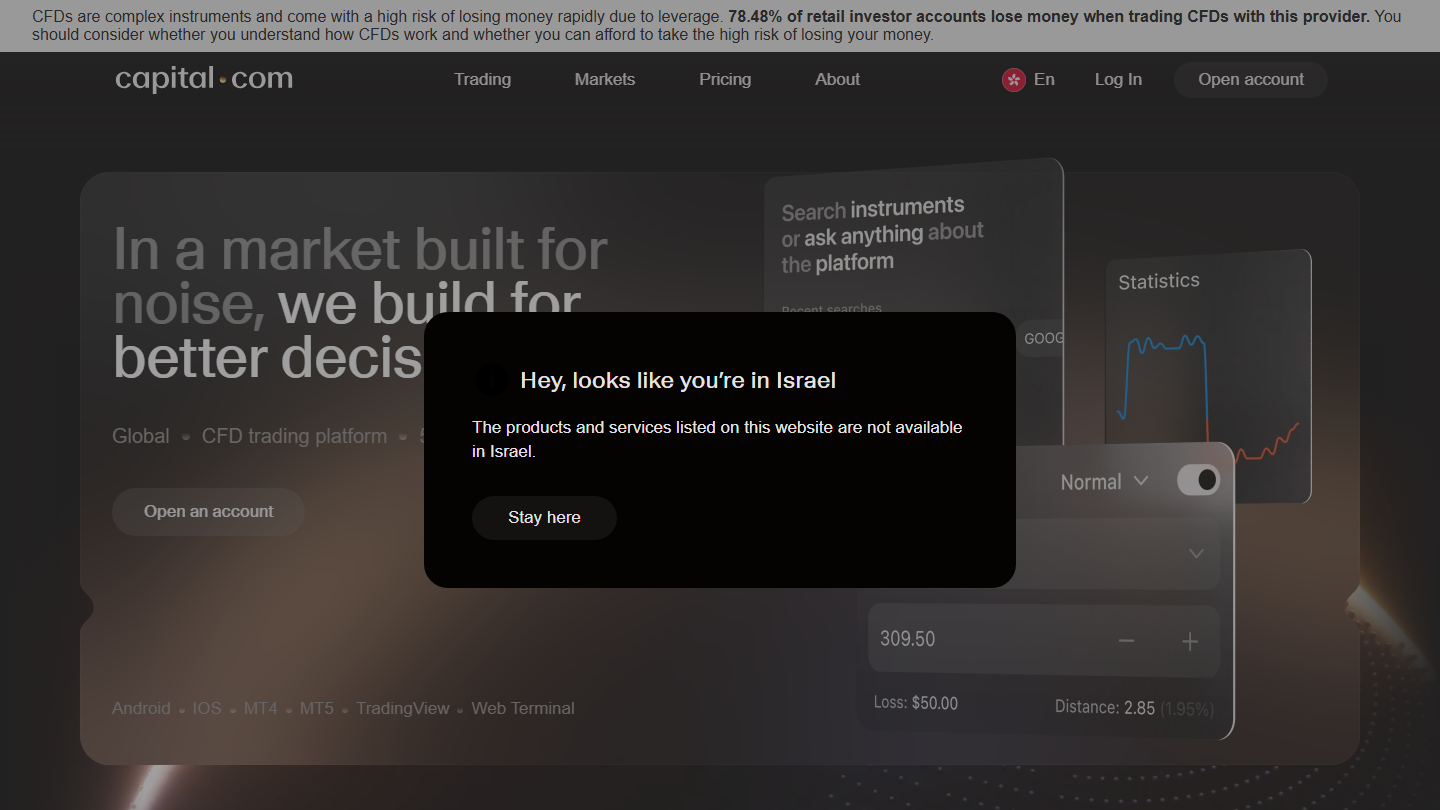
Risk warning: CFDs are complex leveraged instruments and most retail traders lose money on them. Capital.com’s own disclosures put the proportion of losing retail accounts at 78.48% on its international entity and 61% on its UK entity; those figures are updated periodically and differ by entity. A strong regulator, tight spreads and fast withdrawals change none of it. Do not trade with money you cannot afford to lose, and treat leverage as the amplifier of losses that it is. Nothing here is investment advice or a prediction of any outcome.
Is Capital.com trustworthy?
Is Capital.com a scam?
No. We verified four active licences against the regulators’ own registers, including three tier-1 authorities, and re-confirmed them on 27 July 2026. The firm reported $3.42 trillion in client volume in 2025, publishes quarterly operating figures, and carries Lloyd’s of London insurance above the statutory schemes. We found no active regulator warning or enforcement proceeding, and our own deposit, trading and withdrawal completed without obstruction.
Has Capital.com ever been fined by a regulator?
Once, to our knowledge. CySEC fined the Cyprus entity €10,000 in April 2022 for late filing of two suspicious transaction reports. The firm did submit them, no prior similar breaches were recorded, and no restriction was placed on the licence. A minor administrative matter, but we disclose it rather than leaving you to find it elsewhere.
Is Capital.com on any regulator’s warning list?
Not on any we could verify. Some aggregators claim it appears on the Securities Commission Malaysia Investor Alert List; we checked that list directly and found no such entry, nor anything on the FCA Warning List. Clone websites impersonating well-known brokers are common, so always reach the platform through the official domain.
Can I actually withdraw my money?
Yes, based on our own test: $200 arrived within one business day with no fee. Where complaints exist they point to incomplete verification or a name mismatch between bank and trading account. Note that profits above your original deposit must route to a bank account rather than a card.
Will I make money trading here?
Most people do not. Capital.com discloses that 78.48% of retail accounts on its international entity lose money, and 61% on its UK entity. We assess brokers, not outcomes. A good broker lowers your costs and protects your funds; it does not change the odds of the trades you place.
Frequently asked questions
What is the minimum deposit at Capital.com?
$20 by card, Apple Pay, Google Pay or e-wallet, and $50 by bank transfer, among the lowest entry points at any tier-1 regulated broker, with no features restricted at small balances.
Does Capital.com charge an inactivity fee?
No. It previously charged $10 a month after twelve months of dormancy under the Cyprus and Bahamas entities. That fee was abolished in late March 2026 and now applies to no account, regardless of balance.
Does Capital.com offer MetaTrader 5?
Yes in selected jurisdictions, with full Expert Advisor support, but not to UK clients as at July 2026. MT4 and TradingView integration are available alongside the proprietary web and mobile platforms.
How long do withdrawals take?
Capital.com processes 99% of requests within 24 hours. Our $200 card withdrawal was confirmed in two hours and landed in one business day. Arrival depends on method: e-wallets near-immediate, cards up to 24 hours, bank transfers four to five business days. No withdrawal fees apply.
Does Capital.com offer swap-free accounts?
Yes, as a modification to the Standard account, on request in eligible countries. Ours was activated within one business day and required no open positions at the time. We saw no substitute administration fee during testing, but confirm the covered instrument list with support before holding long-term positions.
Can I buy real shares through Capital.com?
No. Every instrument is a contract for difference, so you trade price movement without owning the underlying asset or holding shareholder rights. For long-term share ownership you need a different broker.
Reader reviews
Traded with this broker? Tell others what actually happened.