
Evest competes on its own platform and its support desk rather than on price or regulatory standing. We opened a live account, funded it with $500, placed 50 trades and ran a withdrawal through to a bank account over roughly three weeks in February and March 2026. We found a clean, beginner-friendly platform wrapped around one of the weaker regulatory structures and one of the more expensive fee schedules we have assessed.
Disclosure: Evest is a commercial partner of this site and we may earn a commission if you open an account after visiting from one of our pages. It does not change our findings, our scores or where a broker places in our rankings. Read how we make money.
| Overall rating | 4.2/10 |
|---|---|
| Founded | 2020 |
| Headquarters | Port Vila, Vanuatu |
| Main licences | VFSC (Vanuatu) 17910; FSCA (South Africa) 36060 |
| Minimum deposit | $250 |
| Spread from | 0.5 pips (Diamond account) |
| Maximum leverage | 1:400 |
| Instruments | 400+ |
| Swap-free account | Available on all tiers |
| Retail loss rate | Over 75% |
The six weighted categories behind that score are set out in how we rate brokers. Before republishing we re-checked the licence registers, fee schedule and ownership structure; where anything moved, we say so.
Pros and cons
Evest is easier to like on first contact than to recommend after three weeks.
What works:
- Live chat answered in under three minutes on all three occasions we tested it
- An uncluttered proprietary browser platform with 50+ indicators and one-click execution
- Swap-free accounts on every tier, activated on request rather than gated behind a big deposit
- No commission on any account type: the spread is the only trading charge
- Over 400 instruments across forex, share CFDs, indices, commodities and crypto
- Free deposits on every method we tested
What does not:
- No tier-one licence, and therefore no investor compensation scheme behind your balance
- A $75 inactivity fee after two dormant months, then $50 monthly (among the highest we have recorded)
- The Silver account carried the widest spreads of any broker in our comparison set
- A 2% currency conversion charge on trades outside your account currency, roughly double the industry norm
- MetaTrader was not available during testing, ruling out expert advisors and backtesting
- The $250 minimum is high next to brokers opening accounts from $5
Company information
Evest is a brand of ATRIAFINANCIAL HOLDINGS LTD, a UK holding company (12745548), with ATRIAFINANCIAL LTD in Port Vila as the main operating entity. Ali Hassan has been chief executive since launch. Our original review dated the founding to September 2020; Companies House shows incorporation on 15 July 2020, and we have corrected that. The company remains active, with accounts last filed to 31 December 2024. Six years is a short history next to XM, Pepperstone and IC Markets, which date from 2009, 2010 and 2007.
Re-checking the group’s regulatory disclosure page in July 2026, we found two entities absent from our February research: ATRIAFINANCIAL BUSINESS SERVICES LTD in Cyprus (HE 419548) and ATRIAFINANCIAL CAPITAL LIMITED in the UK (10356128). Both are company registrations, not financial licences: a Cyprus company number is not CySEC authorisation and a Companies House number is not FCA permission. Listing them beside genuine licences invites a reader to conflate the two.
| Detail | Value |
|---|---|
| Holding company | ATRIAFINANCIAL HOLDINGS LTD (UK, 12745548) |
| Main operating entity | ATRIAFINANCIAL LTD (Vanuatu) |
| Incorporated | July 2020 |
| Headquarters | Port Vila, Vanuatu |
| Chief executive | Ali Hassan |
| Instruments | 400+ |
Who this broker suits (and who it does not)
Evest fits a narrow profile: a newer trader who wants a simple platform, a responsive support desk and a swap-free account, and who accepts offshore regulation as the price. Traders who find MetaTrader off-putting will reach their first trade faster here.
It suits others badly. If you run expert advisors or backtest strategies, the absence of MetaTrader is disqualifying rather than inconvenient. If you trade often enough that spread compounds, the Silver account is the wrong place. And if regulatory protection is your first concern, FCA, CySEC and ASIC brokers offer a materially different safety net.
Licensing and regulation
We verified Evest’s claims against the regulators’ own registers in February 2026 and again in July 2026, and the picture worsened in the interval.
| Regulator | Entity | Number | Standing |
|---|---|---|---|
| VFSC (Vanuatu) | ATRIAFINANCIAL LTD | 17910 | Tier three, offshore |
| FSCA (South Africa) | ATRIAFINANCIAL SA (PTY) LTD | 36060 | Tier two |
| MISA (Mwali, Comoros) | ATRIAFINANCIAL (COMOROS) LTD | T2023414 | Not a valid licence |
Our March 2026 review presented MISA number T2023414 as a third-tier offshore licence. It should not have been presented as a licence at all. The Central Bank of the Comoros has stated publicly that approvals issued by island-level bodies, MISA among them, carry no legal effect within the Union for banking or financial-institution activity, a position re-published as recently as December 2025. We have removed it from the count. Evest holds two licences, not three.
The two that remain are real but limited. The VFSC principal licence under the Financial Dealers Licensing Act is a genuine authorisation, but Vanuatu’s supervisory intensity is not comparable to a tier-one regime. The FSCA authorisation sits a step higher and caps forex leverage at 1:200 for clients of that entity against 1:400 on the Vanuatu book. Establish which entity will hold your account before funding, because it determines the terms you get.
What is absent matters more. There is no FCA, CySEC, ASIC or BaFin authorisation, which means:
- No statutory compensation scheme. FCA clients are covered by the FSCS up to £85,000 and CySEC clients by the ICF up to €20,000; Evest clients by nothing
- No tier-one obligation to segregate client money to audited standards
- No binding retail leverage cap. FCA and ESMA rules limit retail forex leverage to 1:30; Evest offers 1:400
- Lighter conduct supervision and less frequent regulatory reporting
We also checked the warning lists. As at 27 July 2026 we found no entry for Evest or Atria Financial on the FCA warning list, or on the CySEC, ASIC, CONSOB, CNMV, Belgian FSMA or Malaysian SC alert lists. There is no active regulator warning against this broker, and we state that as plainly as the criticisms. Several commercial vetting sites published claims in mid-2026 that they could not match Evest’s licence numbers to register entries; those are private checks rather than regulator findings, and we could not confirm them. Evest is also not licensed by the DFSA.
Opening an account and verification
Registration took under five minutes in February 2026: name, email, phone, country. Questions about income source, expected investment size and prior experience came later at full KYC, which lets you inspect the platform before handing over sensitive information.
Verification took roughly 24 working hours after we uploaded a passport scan and a recent utility bill, around the industry average. Evest accepts a passport or national ID plus a utility bill or bank statement. Make sure the address on your proof matches your registration details; a mismatch is the most common cause of delay at any broker.
Expect contact: we received three calls from an assigned account manager in the first week. They were courteous, but do not make a funding decision on one. A demo account with $25,000 in virtual funds needs no deposit, and we would use it for at least two weeks first.
Account types
| Feature | Silver | Gold | Platinum | Diamond |
|---|---|---|---|---|
| Minimum deposit | $250 | $5,000 | $20,000 | $50,000 |
| Spread from | 1.8 pips | 1.4 pips | 0.9 pips | 0.5 pips |
| Commission | None | None | None | None |
| Account manager | Standard | Dedicated | Senior | VIP |
| Daily analysis | Yes | Yes + SMS | Yes + Trading Central | Yes + exclusive |
| Withdrawal fee | $5 | $5 | $5 | Free |
| Swap-free option | Yes | Yes | Yes | Yes |
The spread gap between entry and top tier is more than three-fold: 1.8 pips on Silver against 0.5 on Diamond for EUR/USD. The trader depositing $250, least able to absorb costs, pays the most per trade. Evest is far from alone in this, but we score it against the broker: IC Markets and Pepperstone give every client the same raw pricing regardless of balance, and XM‘s Ultra Low account starts from 0.6 pips at a $5 minimum.
Swap-free accounts
Swap-free trading is available across all four tiers rather than restricted to premium clients, and positions carry no overnight interest. It is a real product feature with a broad audience: traders following Islamic finance principles, and anyone who would rather not carry a financing charge that moves with rate differentials.
The mechanics carry the cost. Activation is a single request to support, and every instrument on standard accounts is available swap-free. Swap is removed entirely, but from the fourth day a position is held an administration charge applies on a published schedule varying by instrument and position size. That three-day grace period is short. Day traders closing before the session ends never meet the charge; swing traders should model the total cost first, because while the charge is not interest, on a long-held position it can be comparable in size to the swap it replaces.
Fees and trading costs
We measured spreads on a Silver account during active London and New York hours in February 2026, against three brokers tested on the same instruments. These are averages in liquid conditions; spreads widened noticeably around the US close and the start of the Asian session.
| Instrument | Evest (Silver) | XM (Standard) | Pepperstone (Standard) | IC Markets (Standard) |
|---|---|---|---|---|
| EUR/USD | 1.8 pips | 1.6 pips | 1.0 pips | 0.8 pips |
| GBP/USD | 2.4 pips | 2.1 pips | 1.2 pips | 1.0 pips |
| USD/JPY | 2.0 pips | 1.6 pips | 1.1 pips | 0.9 pips |
| AUD/USD | 2.2 pips | 1.8 pips | 1.2 pips | 0.8 pips |
| USD/CHF | 2.3 pips | 1.9 pips | 1.4 pips | 1.0 pips |
| Gold (XAU/USD) | 35 cents | 30 cents | 20 cents | 15 cents |
| Oil (WTI) | 5.0 cents | 4.0 cents | 3.0 cents | 2.5 cents |
Evest’s entry account was the most expensive on every instrument measured, with the widest margins on gold and oil. Pricing becomes competitive on Platinum and Diamond, but reaching those tiers costs $20,000 and $50,000. There is no commission on any tier, though IC Markets’ raw-spread account, at around $3.50 per side from near-zero spread, works out lower for an active trader.
A 2% currency conversion fee applies to trades denominated outside your account currency, roughly double the 0.5% to 1% we typically see.
The inactivity fee is the worst term in the schedule: $75 after two dormant months when we checked, then $50 per month. XM waits 90 days and charges $5 monthly; IC Markets charges nothing. On a small account this drains the balance quickly, so withdraw or close rather than leaving it dormant.
Desktop platforms
Evest runs a proprietary platform. During our testing in the first quarter of 2026, MetaTrader 4 and MetaTrader 5 were not available to us. Third-party sources reported MT5 connectivity later in 2026, which we could not verify at the time of publication; treat MetaTrader access as unconfirmed rather than available.
WebTrader is an HTML5 platform running in the browser with nothing to install. It offers a clean interface, multi-timeframe charting with more than 50 indicators, one-click execution, depth of market, and an economic calendar filterable by event importance. What it lacks is more consequential: no automated trading, no expert advisors, no backtesting, no external signal providers, and limited advanced charting next to MT4 and MT5.
Charts loaded quickly over a 50 Mbps connection and we saw no freezing in normal conditions. During the US non-farm payrolls release on the first Friday of February 2026, we recorded a two to three second lag in chart price updates. That is not unusual, but it matters if your strategy depends on reacting to one.
Mobile apps
We used the Android app for a full week in February 2026. Published on Google Play and the App Store, it mirrors WebTrader and adds price and news notifications, Face ID and Touch ID login, and the same economic calendar. Performance was smooth and charts legible. Two negatives: it drew more battery than expected with charts left open, and app-store reviewers report price update lag during sharp volatility, matching the chart lag we saw on desktop.
Public sentiment has moved against Evest since we first published. In March 2026 its Trustpilot score stood at roughly 4.3 out of 5 across more than 440 reviews; re-checking in July 2026, it had fallen to approximately 3.3 across around 520 reviews, with delayed withdrawals now the dominant theme in negative feedback rather than one complaint among several. Trustpilot is a self-selecting sample, but a one-point fall in four months alongside a shift in complaint type is a signal, not noise.
Trading tools
| Asset class | Approximate count | Examples |
|---|---|---|
| Forex pairs | 45+ | EUR/USD, GBP/USD, USD/JPY, plus minors and emerging-market pairs |
| Share CFDs | 300+ | Apple, Tesla, Amazon, Microsoft, NVIDIA, Meta, plus European names |
| Indices | 15+ | S&P 500, NASDAQ, FTSE 100, DAX 40 |
| Commodities | 10+ | Gold, silver, crude oil, natural gas |
| Cryptocurrencies | 15+ | Bitcoin, Ethereum, Litecoin, Ripple |
The share CFD range is the strongest part of the offering, and commission-free equity trading is a genuine advantage. The forex list at 45-plus pairs is thinner than IC Markets’ 60-plus, the crypto selection covers major coins only, and we found no ETFs and no bonds.
Leverage runs to 1:400 on forex, 1:100 on shares and indices, and 1:20 on crypto, ceilings that follow directly from the offshore regulatory environment. At 1:400 a $250 deposit controls a $100,000 position, so a 0.25% move against you wipes out the balance. The FCA and ESMA cap retail forex leverage at 1:30 precisely because of that arithmetic. Leverage magnifies losses at exactly the rate it magnifies gains, and most retail accounts lose money trading these products.
Order execution
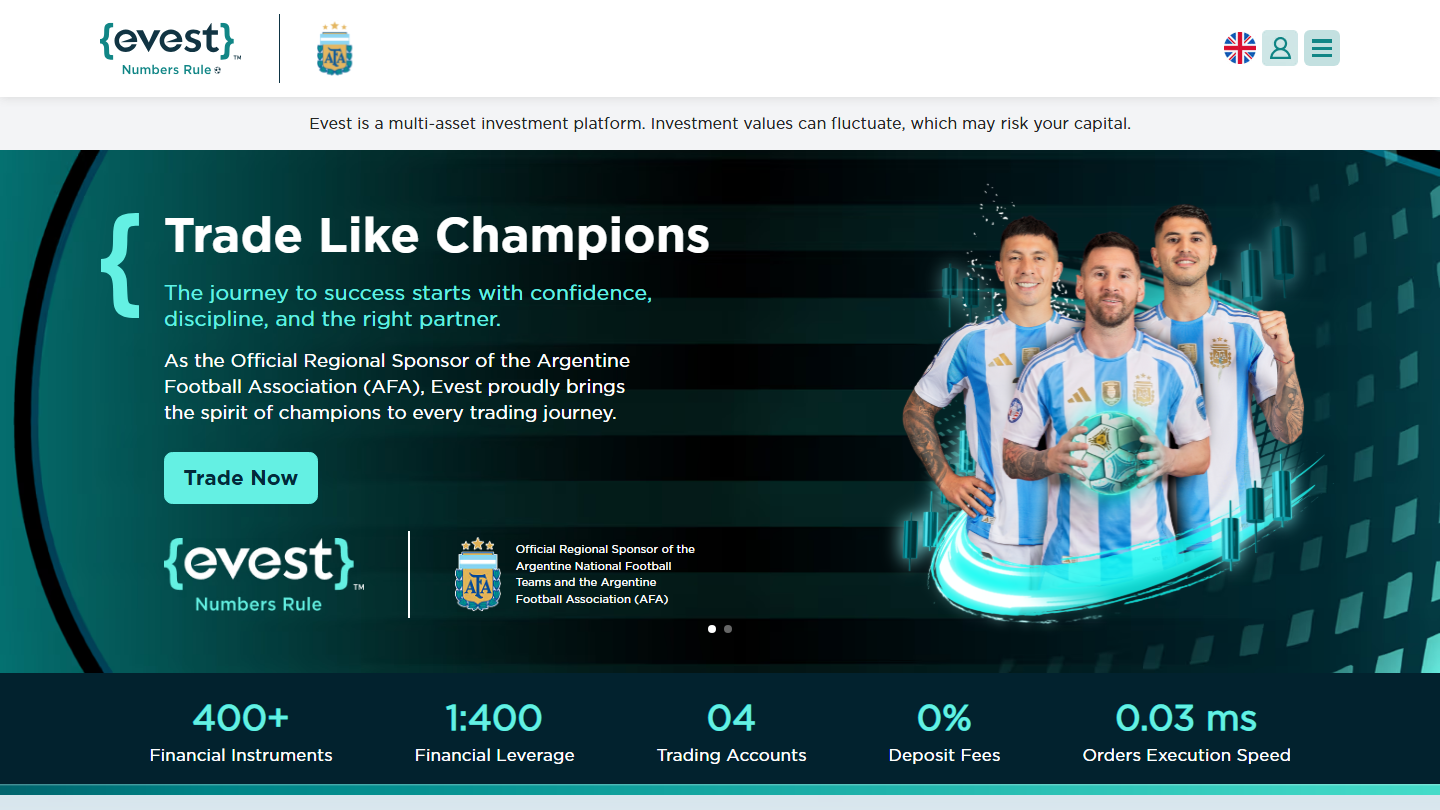
We placed 50 trades across major forex pairs, gold, oil and share CFDs. Execution was good in normal conditions: most orders filled at the requested price, and where slippage occurred it did not exceed 0.1 pips. Evest advertises execution of 0.03 milliseconds, a marketing figure we cannot verify and would not weight.
Under volatility that changed. Around Federal Reserve announcements and US employment data, spreads widened materially and some orders took longer to fill, with gold slipping more than the majors. The spread table describes calm markets, not news events.
Evest operates a market-maker model, so the broker may be the counterparty to your trade rather than routing it to external liquidity providers. Market makers can offer steadier spreads and sometimes faster fills, but the model creates a structural position in which your gain is the broker’s loss. Traders who want that conflict removed should look at ECN or STP brokers.
Deposits
We funded the account with $500 by Visa and the balance appeared within minutes; a Skrill deposit credited at about the same speed.
| Method | Minimum | Fee | Processing time |
|---|---|---|---|
| Visa / Mastercard | $250 | Free | Instant |
| Visa Electron | $250 | Free | Instant |
| Bank transfer | $250 | Free | 3-5 business days |
| Skrill | $250 | Free | Instant |
| Neteller | $250 | Free | Instant |
Free deposits across the board is a genuine positive, but the menu is narrow: cards, bank transfer and two e-wallets, with no PayPal and no instant local bank rails of the kind UK and EU traders expect. The $250 minimum applies to every method and tier.
Withdrawals
We requested a $200 withdrawal to a Visa card in February 2026 and the money reached our bank account five business days later, inside Evest’s stated seven-day window, but slow next to Pepperstone, which typically processes withdrawals within one day.
| Method | Minimum | Fee | Processing time |
|---|---|---|---|
| Visa / Mastercard | $25 | $5 | 3-7 business days |
| Bank transfer | $25 | $5 | 5-7 business days |
| Skrill | $25 | $5 | 1-3 business days |
| Neteller | $25 | $5 | 1-3 business days |
Our withdrawal completed without obstruction, and that has to be set against the complaint trend: since our original testing, delayed-withdrawal reports have become the most common negative theme in Evest’s public reviews, some describing requests under review for weeks. One clean test does not disprove other people’s experience.
The $5 flat fee looks trivial until you withdraw small sums: on the $25 minimum it is 20% of the amount. Evest applies the standard rule that funds return by the deposit method first, up to the amount deposited, which is awkward if you have since closed that card. International bank transfers attract intermediary charges of roughly $15 to $30 on top. This is uncompetitive: Pepperstone offers free withdrawals on most methods, IC Markets charges nothing on cards and e-wallets, and XM gives one free withdrawal monthly.
Customer support
Support is the strongest thing about Evest, and we tested it. We opened live chat on three occasions (Monday morning at peak, Wednesday evening and Friday afternoon) and reached a human agent in under three minutes each time. Asked about account tiers and fees, we got correct figures rather than deflection. An email query about swap-free settings drew a substantive reply in eight hours.
| Channel | Availability | Response time in our tests |
|---|---|---|
| Live chat | Monday-Friday, 08:00 to midnight | Under 3 minutes |
| Seven days | 4-8 hours | |
| Telephone | Monday-Friday, 08:00 to midnight | Immediate |
| Ticket system | Seven days | 12-24 hours |
Localisation deserves credit: the interface, help centre and educational material are properly translated rather than machine-processed. One caveat matters: the responsiveness we saw on general queries is not what many public reviewers describe when the subject is a stalled withdrawal, and we only ran the first test.
Research and education
Evest runs an education portal at academy.evest.com with video lessons, live webinars, daily market analysis, an economic calendar and written material on strategy and risk management, tiered beginner to advanced. We attended one live webinar: the presenter was knowledgeable, the material on gold in a high-rate environment useful, and attendance open to all tiers rather than gated by deposit. The quality is solid for beginners and thin beyond that.
Gold accounts and above receive daily trade signals by SMS, and Platinum adds Trading Central analysis. We would not build a strategy on broker-supplied signals at any tier; no signal service removes the risk from a leveraged position.
Fund safety and protections
| Protection | Evest | Tier-one regulated brokers |
|---|---|---|
| Client fund segregation | Stated by the broker, without tier-one enforcement | Mandatory by law, independently audited |
| Negative balance protection | Stated by the broker | Mandatory by law |
| Investor compensation scheme | None | FSCS up to £85,000; ICF up to €20,000 |
| Independent financial audit | Not clearly disclosed | Mandatory annually |
| Regulatory reporting | Limited (VFSC / FSCA) | Comprehensive and quarterly |
If Evest were to fail financially, no compensation scheme would cover your balance. That is regulatory fact, not prediction; plenty of offshore-licensed brokers operate honestly and return client money on demand, as ours was. The difference is the legal safety net if something goes wrong, the layer of fund safety that regulation, rather than goodwill, provides. More than 75% of retail investor accounts lose money trading CFDs with this provider, so never deposit money you cannot afford to lose.
Verdict
After more than three weeks of live testing, our score for Evest is 4.2 out of 10, the lowest we have published across our broker reviews. That is lower than the 3.4 out of 5 our original review carried, and the reason belongs in the open. We no longer score regional-language experience as a separate weighted category, and that was Evest’s single best attribute; removing it removes the counterweight holding the score up. Regulation then fell after re-verification: the Comoros licence turned out not to be a licence, leaving two authorisations rather than three. Withdrawals softened on the complaint trend. No measured finding changed.
Evest is a legitimate, licensed business with a good platform and an unusually strong support desk. It is also expensive on its entry tier, thinly regulated, and penalises dormant accounts harder than almost anyone. If your priorities are oversight, low costs and advanced tooling, Pepperstone or IC Markets fit better.
Risk warning: More than 75% of retail investor accounts lose money when trading CFDs with this provider. Leveraged products carry a high risk of rapid loss. Consider whether you understand how CFDs work and whether you can afford to take the high risk of losing your money. Nothing here is investment advice or a recommendation to trade, and past performance does not indicate future results.
Is Evest trustworthy?
Is Evest a scam? No. It is a registered business holding verifiable VFSC and FSCA authorisations, and we opened an account, deposited, traded and withdrew successfully. But “not a scam” and “well protected” are different claims, and the difference only becomes visible when something goes wrong.
Is Evest under any regulator warning? Not that we could find. As at 27 July 2026 there was no entry for Evest or Atria Financial on the FCA, CySEC, ASIC, CONSOB, CNMV, Belgian FSMA or Malaysian SC warning lists. Commercial vetting sites published claims in mid-2026 that they could not match Evest’s licence numbers to register records; those are private checks, not regulator findings, and we could not confirm them.
Does Evest really hold three licences? No: two. VFSC 17910 and FSCA 36060 are genuine. The Comoros MISA licence (T2023414) is not valid: the Central Bank of the Comoros has stated that approvals from island-level bodies carry no legal effect within the Union. Our original review listed it as a third-tier licence and we have corrected that. The group’s Cyprus and UK company registrations are corporate filings, not authorisations.
Can I actually withdraw my money? In our test, yes: $200 by Visa reached the bank in five business days. Public complaints about delays have increased since, with the Trustpilot score falling from roughly 4.3 to about 3.3 between March and July 2026. Complete KYC fully before requesting anything, and withdraw by the method you deposited with.
What do traders complain about most? Across more than 100 public reviews and forum threads: withdrawal delays, persistent account-manager calls, and the inactivity fee. Users consistently praise the platform’s simplicity and the support desk.
Frequently asked questions
What is the minimum deposit at Evest?
$250 for Silver, $5,000 for Gold, $20,000 for Platinum and $50,000 for Diamond. That is high compared with brokers accepting deposits from $5.
Is Evest regulated?
By two authorities: the VFSC in Vanuatu (17910) and the FSCA in South Africa (FSP 36060). Neither is tier-one, so there is no compensation scheme. The MISA (Comoros) licence Evest also lists carries no legal effect and should not be counted.
Does Evest offer swap-free accounts?
Yes, on all four tiers, activated by request to support. Overnight interest is removed entirely, but from the fourth day a position is held an administration charge applies on a published per-instrument schedule.
How long do Evest withdrawals take?
Our $200 Visa withdrawal took five business days in February 2026; Skrill and Neteller are quoted at one to three. A flat $5 fee applies, waived on Diamond, with a $25 minimum.
Does Evest support MetaTrader?
Not during our testing. Its proprietary browser platform and mobile app do not support expert advisors, algorithmic trading or backtesting. Third-party sources reported MT5 connectivity later in 2026; we could not verify this at the time of publication.
What is Evest’s inactivity fee?
$75 after two months without trading, then $50 per month. That is among the highest in the industry. XM waits 90 days and charges $5 monthly, and IC Markets charges nothing.
Reader reviews
Traded with this broker? Tell others what actually happened.