
Pepperstone built its reputation on execution speed and raw pricing, and both held up in our testing: across 50 live orders the median fill landed around 30 milliseconds, and EUR/USD on the Razor account averaged 0.09 pips before commission, close to the tightest spread available in retail CFD trading. The reservations are narrower but real. Gold pricing lags cheaper rivals, the swap-free account carries a steep substitute charge, and clients outside the UK, EU and Australia are onboarded under a Bahamas entity that lost its external dispute-resolution backstop in February 2026.
Disclosure: we may earn a commission if you open an account through links on this page. It does not affect our findings, our scores, or the order brokers appear in. Read how we make money.
| Overall rating | 8.5/10 |
|---|---|
| Founded | 2010 |
| Headquarters | Melbourne, Australia |
| Main licences | FCA UK (684312), ASIC Australia (414530), CySEC Cyprus (388/20), DFSA Dubai (F004356) |
| Minimum deposit | $0 technically; $200 recommended, and required for swap-free |
| Spread from | 0.0 pips (Razor account) |
| Maximum leverage | 1:30 retail (UK/EU/AU); up to 1:500 for qualified professional clients |
| Instruments | 1,350+ |
| Swap-free available | Yes, with a $100 per standard lot admin fee after day five |
| Retail loss rate | 72.9% (Pepperstone Limited, UK, verified July 2026) |
We opened a live account, funded it, placed real trades, requested a real withdrawal and contacted support without identifying ourselves as reviewers. Read our full methodology. The account and platform testing ran through February 2026; every licence, fee and entity claim below was re-checked against the regulators’ own registers and Pepperstone’s published schedules on 27 July 2026.
Pros and cons
What we liked
- Razor pricing genuinely starts at 0.0 pips on major pairs. Our measured EUR/USD average was 0.09 pips before commission.
- Median execution around 30 milliseconds across 50 live orders, with 47 filled at the requested price.
- Four platforms under one account: MT4, MT5, cTrader and TradingView. Very few brokers offer all four.
- Four tier-1 licences (FCA, ASIC, CySEC, DFSA), all confirmed active on the regulators’ registers in July 2026.
- No inactivity fee at all, at any point. Dormant accounts are archived rather than charged.
- More than 1,350 instruments, including over 1,000 single-stock CFDs.
What we did not
- The swap-free account charges $100 per standard lot once a position passes day five, among the steepest substitute fees we have measured.
- Gold spread averaged 1.30 pips against 0.30 at Exness and 1.00 at IC Markets. Metals traders are paying a premium here.
- Pepperstone withdrew from the Financial Commission on 27 February 2026, removing the external dispute-resolution route and €20,000 compensation fund that previously covered Bahamas-entity clients.
- Tightened withdrawal documentation introduced in January 2026 adds friction to a first payout.
- Email support was the weak channel: 4 to 12 hours in our tests, and around 10 hours for a Friday evening enquiry.
- No proprietary desktop platform. The trading experience is entirely third-party software.
- CFDs only. There is no real share dealing, so you never own the underlying asset.
Company information
Pepperstone was founded in Melbourne in 2010 by Owen Kerr and Joe Davenport, and its head office remains at 727 Collins Street, Melbourne. Tamas Szabo, previously two decades at IG Group, has been group chief executive since 2017 and was still in post when we re-checked in July 2026.
Scale is what separates Pepperstone from most of the brokers it competes with on price. It operates in more than 150 countries, serves over 830,000 active clients, processes monthly traded volume above A$1 trillion, and pays out more than A$100 million in client withdrawals a month. That places it inside the top ten retail forex and CFD brokers worldwide by volume. That matters practically: deep flow tends to mean stable fills when the market moves fast.
The group runs separately incorporated entities in Australia, the UK, Cyprus, Germany, the UAE, Kenya and the Bahamas. Re-verifying the structure in July 2026 we counted eight licensed entities rather than the seven recorded during our original testing: Pepperstone Financial Services LLC, authorised by the UAE Securities and Commodities Authority, now sits alongside the DIFC entity. Which entity holds your account is set by your country of residence, and it is the single most consequential fact about the relationship.
One corporate matter is worth stating plainly because it surfaces in search results. In March 2026 an Australian court ordered FX Group Holdings, Pepperstone’s majority shareholder, to pay A$96.9 million plus interest to CPE Capital over a profit-sharing dispute arising from the 2018 management buyout, with an appeal pending. It is a shareholder-level contract dispute: the regulated broking entities were not party to it, no regulator was involved, and it is not a finding against Pepperstone’s conduct as a broker.
Who this broker suits (and who it does not)
Pepperstone fits active traders who care about the total cost of a round turn; scalpers and intraday traders who need fills measured in milliseconds; algorithmic traders running expert advisors or cBots, who benefit from having MT4, MT5 and cTrader available on one login; and anyone who wants TradingView charting wired directly to a live account. It also suits traders who go quiet for months at a time, because nothing is deducted from a dormant balance.
It does not fit position traders using the swap-free account, where the $100 per lot charge after day five makes multi-week holds expensive; gold-focused traders, who will find materially tighter metals pricing elsewhere; complete beginners who want a heavily structured education programme, where XM and IG are stronger; anyone who wants to own actual shares rather than trade CFDs on them; and traders outside the UK, EU and Australia who specifically want a compensation scheme standing behind their account.
Licensing and regulation
Pepperstone’s regulatory position is one of the strongest in retail CFD broking. We checked each licence against the regulators’ own registers during our original testing and again on 27 July 2026; all were active on both occasions, with no enforcement action against any entity.
| Regulator | Entity | Licence | Tier |
|---|---|---|---|
| FCA (United Kingdom) | Pepperstone Limited | 684312 | Tier 1 |
| ASIC (Australia) | Pepperstone Group Limited | 414530 | Tier 1 |
| CySEC (Cyprus) | Pepperstone EU Limited | 388/20 | Tier 1 |
| DFSA (Dubai, DIFC) | Pepperstone Financial Services (DIFC) Limited | F004356 | Tier 1 |
| BaFin (Germany) | Pepperstone GmbH | 151148 | Tier 1 |
| CMA (Kenya) | Pepperstone Markets Kenya Limited | 128 | Tier 2 |
| SCB (Bahamas) | Pepperstone Markets Limited | SIA-F217 | Offshore |
You can confirm the UK licence yourself on the FCA Financial Services Register in under a minute, and the Dubai entity on the DFSA public register.
Which entity you actually get
UK residents are onboarded under Pepperstone Limited (FCA), EU residents under Pepperstone EU Limited (CySEC), German clients under Pepperstone GmbH (BaFin) and Australians under Pepperstone Group Limited (ASIC). Those four routes give a tier-1 supervised account, and in the UK and EU cases a compensation scheme behind it. Traders outside those jurisdictions are typically routed to Pepperstone Markets Limited in the Bahamas under SCB licence SIA-F217, which segregates client money and provides negative balance protection but is supervised more lightly with no compensation scheme. Check which entity’s terms you are signing before you fund the account, not after.
An impersonation warning you should know about
The FCA warning list carries an entry for “PepperStone VIP / EMC Capitals”, first published on 4 March 2025. This is not a warning against Pepperstone: it names an unauthorised operation trading on the Pepperstone name, not the licensed broker. We flag it because clone and lookalike firms are the most common way people lose money to a broker they thought they had researched. Reach Pepperstone only through pepperstone.com, and check any firm claiming to be it against the FCA’s warning list before sending money.
Opening an account and verification
When we opened an account in February 2026 the online form took about eight minutes. It asks for the usual identity and contact details, then makes you pick an account type (Standard or Razor) and a platform. Both can be changed later.
Verification is a separate step requiring proof of identity (passport, national ID or driving licence) and proof of address (a utility bill from the last six months, or a bank statement). We uploaded a passport image and a PDF bank statement and had confirmation back in 45 minutes, consistent with Pepperstone’s stated five minutes to two hours during business hours.
One thing to plan around: in January 2026 Pepperstone tightened the documentation it requires around withdrawals, so you may be asked for extra paperwork at your first payout rather than at sign-up. The fix is simple: submit every verification document when you open the account, not when you want your money back.
Account types
Pepperstone keeps this simple: two live account types plus a swap-free variant. After reviewing brokers that offer six near-identical accounts, we count the restraint as a point in its favour.
| Feature | Standard | Razor | Swap-free |
|---|---|---|---|
| Minimum deposit | $0 ($200 recommended) | $0 ($200 recommended) | $200 |
| Pricing model | Spread only | Raw spread plus commission | Spread only, no swap |
| EUR/USD average spread | 1.1 pips | 0.09 pips | 1.0–1.2 pips |
| Commission | None | $3.50 per lot per side (MT4/MT5) | None |
| Maximum leverage (retail) | 1:30 | 1:30 | 1:30 |
| Maximum leverage (professional) | 1:500 | 1:500 | 1:500 |
| Platforms | MT4, MT5, cTrader, TradingView | MT4, MT5, cTrader, TradingView | MT4, MT5 |
| Minimum trade size | 0.01 lot | 0.01 lot | 0.01 lot |
| Negative balance protection | Yes | Yes | Yes |
For anyone trading with any frequency, Razor is the better account and the arithmetic is not close. A standard lot of EUR/USD costs roughly 0.79 pips all-in on Razor (0.09 in spread plus about 0.70 in commission expressed as pips) against 1.1 pips on Standard. At ten standard-lot round turns a day that is roughly $3.10 per trade, or over $600 a month in costs avoided. It is a saving on expenses, not a return: it changes what you pay, not what you make. Standard remains reasonable for beginners who want a single number to look at, since the gap on majors is only about 0.3 pips.
Leverage and professional status
Retail clients under the FCA, CySEC and ASIC entities get the standard regulatory caps: 1:30 on major currency pairs, 1:20 on minors, gold and major indices, 1:10 on other commodities, 1:5 on shares and 1:2 on cryptocurrency. Qualified traders can apply for professional classification, lifting the cap to 1:500 on majors, by meeting two of three tests: relevant financial-sector experience, a portfolio above €500,000 or equivalent, or a substantial trading record over the previous twelve months.
Read the trade-off before applying. Professional classification means surrendering retail protections, which in some jurisdictions includes negative balance protection and compensation scheme access. Higher leverage magnifies losses at exactly the rate it magnifies gains, on an account with fewer safety nets under it.
The swap-free account in detail
Pepperstone’s swap-free account removes overnight interest entirely, which makes it relevant both to traders observing Islamic finance principles and to anyone who simply wants overnight financing out of their cost model. It is open to residents of eligible countries and covers the full forex and CFD range.
| Minimum deposit | $200 |
|---|---|
| Swap charges | None |
| Admin fee | $100 per standard lot, applied after day five of holding |
| Grace period | Five days, fee-free |
| Base currencies | AUD, EUR, GBP, USD |
| Platforms | MT4, MT5 |
The substitute charge is the problem. Hold one standard lot for ten days and you pay $100 in admin fees on top of spread, which makes swing trading and carry-style strategies unattractive on this account. We re-verified the $100 figure and the five-day grace period in July 2026; both were unchanged. Competitors including Exness offer longer grace periods and lower substitute charges on some instruments, so compare the admin fee on the instruments you actually trade before committing.
The positive read is that five fee-free days covers intraday and short-swing traders completely: close within the working week and the admin fee never touches you. Whether a swap-free structure satisfies a particular religious requirement is a question for a qualified scholar, not for us; we describe the mechanics, we do not rule on them.
Fees and trading costs
Trading costs are where Pepperstone earns its reputation. We sampled spreads repeatedly across different sessions and days during February 2026. The table shows averages on raw-pricing accounts, commission excluded, against three competitors.
| Instrument | Pepperstone (Razor) | IC Markets (Raw) | Exness (Pro) | XM (Ultra Low) |
|---|---|---|---|---|
| EUR/USD | 0.09 | 0.10 | 0.10 | 0.80 |
| GBP/USD | 0.37 | 0.30 | 0.20 | 0.80 |
| USD/JPY | 0.17 | 0.15 | 0.10 | 0.80 |
| AUD/USD | 0.27 | 0.20 | 0.10 | 0.80 |
| USD/CHF | 0.35 | 0.30 | 0.20 | 0.90 |
| Gold (XAU/USD) | 1.30 | 1.00 | 0.30 | 2.70 |
| Oil (WTI) | 0.02 | 0.02 | 0.04 | 0.03 |
These are averages drawn from Q4 2025 and Q1 2026 sampling. Spreads are variable (we watched them widen at the Asian open and around major releases), so treat any published average as a typical case, not a guarantee. The pattern is clear: on EUR/USD, Pepperstone was the tightest of the four; on gold it was not close, and 1.30 pips against Exness at 0.30 is a meaningful handicap if metals are a large share of your volume.
Commission
Razor commission is $3.50 per standard lot per side on MT4 and MT5, so $7 round turn. Re-checking the published schedule in July 2026, we found the rate is platform-dependent rather than uniform: cTrader is $6 round turn and TradingView $7, making cTrader marginally the cheapest venue for the same trade. Standard accounts carry no commission; the cost sits in a wider spread. IC Markets charges a comparable $3.50 per side; Exness Pro has no commission but a wider raw spread.
Overnight financing, funding and dormancy
Swaps follow the interest rate differential between the two currencies in a pair, with Wednesday charged at triple rate to cover the weekend. In our sampling these sat within normal market ranges: a short EUR/USD position was earning roughly €5.71 per standard lot per day in positive carry on early-2026 rates. Rate differentials move, so treat that as an illustration of the mechanism rather than a current figure.
Deposits are free across every method, and withdrawals are free with one exception: international bank wires. Our original testing recorded a flat $20 or £15 charge; on re-verification in July 2026 the published position is that bank transfer withdrawals are free for EU and Australian clients and around $20 for others. Correspondent banks may add fees of their own regardless of broker.
There is no inactivity fee at any duration. Accounts dormant beyond three months are archived rather than charged, and support can reactivate them. That is genuinely unusual, and worth real money to anyone who trades seasonally.
Desktop platforms
We spent a week with all four desktop platforms. The variety is substantive rather than cosmetic; these are genuinely different tools, not skins of one product.
MetaTrader 4 remains the default for expert advisors, and Pepperstone’s build ships with a larger indicator set than the stock MetaQuotes download. Execution was fast and stable, though the interface is visibly dated. MetaTrader 5 adds 21 timeframes against MT4’s nine, better depth-of-market data, and exposed 1,385 tradeable symbols on our account, the stronger choice for multi-asset traders.
cTrader is the best platform here for scalping: a more modern, noticeably smoother interface, Level II pricing and charts detachable from the main window. Its weakness is community scale, with fewer third-party indicators and bots than MT4. TradingView integration lets you trade directly from TradingView charts against your Pepperstone balance, with Pine Script and over 100 indicators intact, though in our testing it worked with MT4 and MT5 accounts only, not cTrader.
The one structural gap is that Pepperstone has no desktop platform of its own. Everything you trade on is licensed from someone else, so platform roadmaps and outages sit largely outside the broker’s control.
Mobile apps
Mobile options cover the MT4, MT5 and cTrader apps plus Pepperstone’s own app, launched in 2024. We tested the proprietary app on iOS and found it clean and deliberately simplified: good for opening and closing positions and monitoring exposure, thin on analysis. If you make decisions from your phone, MT5 or cTrader remain necessary.
The MetaTrader apps behaved normally, with MT5 noticeably more stable than MT4 on current handsets, and the cTrader app was the strongest of the group. Pepperstone’s own app holds roughly four stars across the app stores: positive reviews cite ease of use and execution speed, negative ones cite occasional crashes and weak charting. That matches our impression: a solid execution utility, not an analysis tool.
Trading tools
Pepperstone provides access to more than 1,350 instruments, all as CFDs. You are trading price movement, not taking ownership of anything.
| Asset class | Approximate count | Notes |
|---|---|---|
| Forex pairs | 90+ | Majors, minors and exotics |
| Share CFDs | 1,000+ | US, UK, Australian and German listings |
| Indices | 28 | S&P 500, Dow Jones, Nasdaq, DAX, FTSE, Nikkei |
| Commodities | 32 | Gold, silver, oil, natural gas |
| ETF CFDs | 100+ | Global index funds |
| Cryptocurrencies | 26 | Bitcoin, Ethereum, Litecoin and others |
Ninety-plus currency pairs covers essentially any FX strategy, and the 1,000-plus share CFD range puts Pepperstone ahead of most price-led competitors, though IC Markets offers wider coverage in some categories. Twenty-six crypto pairs is adequate rather than generous. The absence worth naming is real share dealing: every equity position is a leveraged CFD, so this is not a broker for building an unleveraged long-term portfolio; that needs one of the brokers offering real share dealing.
Order execution
Execution is where Pepperstone measurably outperforms. It runs a no-dealing-desk ECN/STP model, routing orders to liquidity providers rather than taking the other side internally.
We placed 50 orders on a funded live account. The median fill came in around 30 milliseconds, matching the broker’s own claim, and 47 of the 50 filled at the requested price with no meaningful slippage. The three that slipped moved less than 0.2 pips, all during economic data releases, which is when slippage is expected and when its absence would be the suspicious result.
Order types cover market orders, the full set of pending orders (buy and sell stops and limits), stop loss, take profit and trailing stops, with cTrader adding more advanced types on top. Session behaviour was predictable in the right way: liquidity was deepest and spreads narrowest during the European–US overlap, while spreads on minor pairs widened noticeably in the early Asian session. If you trade outside peak hours, budget for that.
Deposits
Our Visa card deposit completed in under a minute and credited instantly. It was among the smoothest funding experiences we have had with any broker.
| Method | Processing time | Minimum | Fee |
|---|---|---|---|
| Visa / Mastercard | Instant | $10 | Free |
| Bank transfer | 1–3 business days | No minimum | Free |
| PayPal | Instant | $10 | Free |
| Skrill | Instant | $10 | Free |
| Neteller | Instant | $10 | Free |
| Apple Pay | Instant | $10 | Free |
| Google Pay | Instant | $10 | Free |
| UnionPay | Instant | $10 | Free |
Pepperstone charges nothing on deposits through any method. Your own bank or wallet may still apply a charge at their end, which is worth checking with them rather than with Pepperstone.
Withdrawals
Withdrawals worked, and worked cleanly, but not quite as fast as the deposit side would lead you to expect, largely because of the additional documentation introduced in January 2026.
| Method | Processing time | Fee |
|---|---|---|
| Visa / Mastercard | Up to 1 business day | Free |
| Domestic bank transfer | Up to 2 business days | Free |
| International bank transfer | Up to 3 business days | Around $20 (free for EU and Australian clients) |
| PayPal | Up to 1 business day | Free |
| Skrill / Neteller | Up to 1 business day | Free |
We requested $300 via PayPal on a Tuesday morning. A confirmation request arrived by email within the hour, the withdrawal was approved, and the funds landed roughly six hours later, comfortably inside the published window.
The practical advice is unchanged: upload every verification document when you open the account. The January 2026 tightening is an anti-fraud and anti-money-laundering measure most licensed brokers have adopted in some form. It slows a first withdrawal for people who left paperwork incomplete; it does not block anyone.
Customer support
Support was competent and knowledgeable, with a clear split between the fast channels and the slow one.
| Channel | Availability | Response time (our tests) |
|---|---|---|
| Live chat | 24 hours on weekdays, 18 hours at weekends | 3–8 minutes |
| Round the clock | 4–12 hours | |
| Phone | 24 hours on weekdays | Answered immediately, 2–5 minute queue |
We opened a live chat on a Monday morning with a question about swap-free terms and reached an agent in five minutes. The answer was accurate and specific: the agent knew the admin fee structure without looking it up, which is not always the case. Email was the weak point: a Friday evening enquiry took roughly ten hours. The reply was thorough when it came, but ten hours is slow for a broker of this scale, and it is why support scores below the rest of the operation.
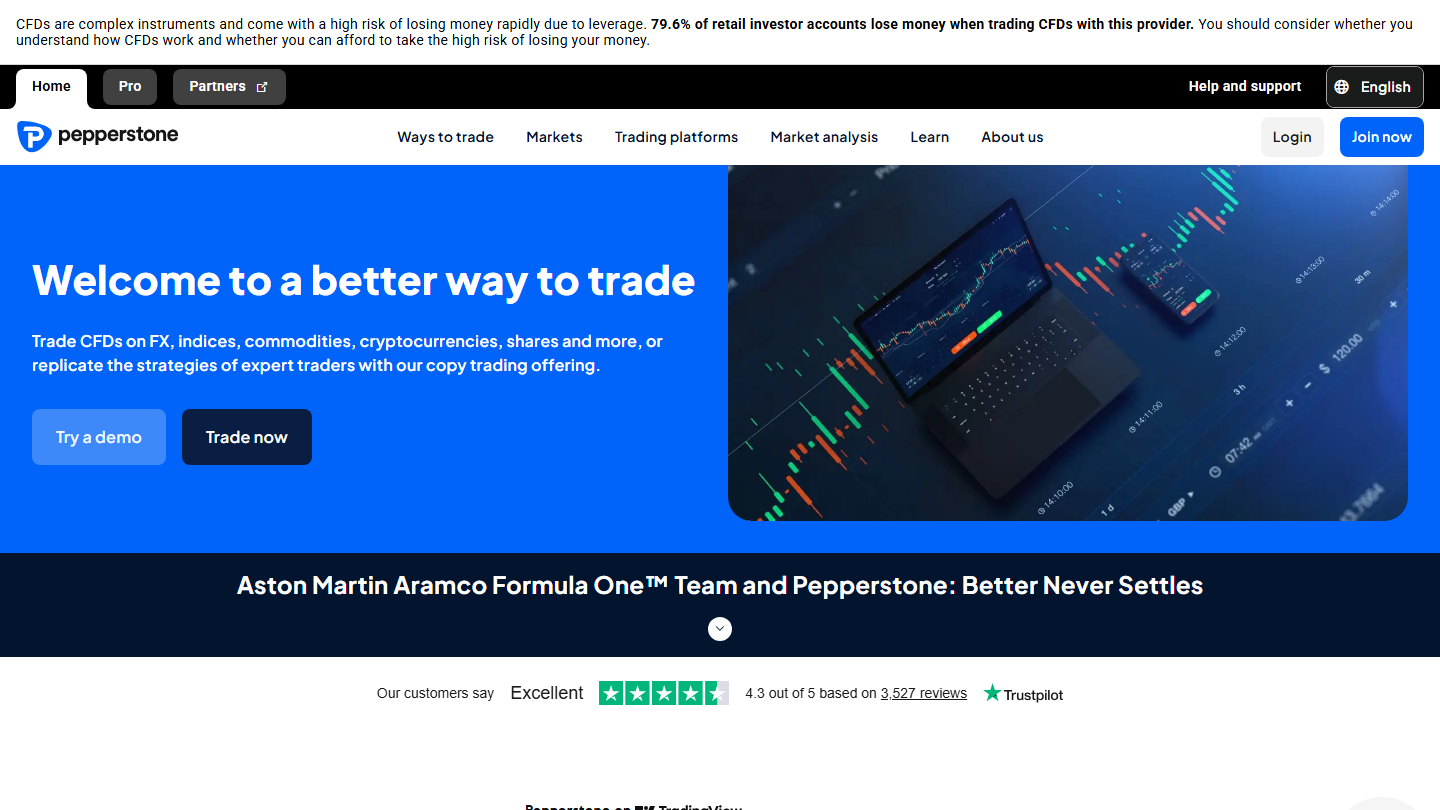
Third-party sentiment broadly matches. On re-checking in July 2026, Pepperstone held a Trustpilot rating of around 4.3 from roughly 3,400 reviews, about 80% at five stars praising speed and service quality, with a minority at one star citing withdrawal delays and platform issues. Our original testing recorded 4.4 from over 3,000 reviews, so the picture is stable.
Research and education
Research is solid and led by a named analyst, which counts for more than volume of output.
- Daily and weekly market analysis headed by Chris Weston, head of research.
- Autochartist free to live account holders, for automated technical pattern recognition.
- An economic calendar with impact analysis on scheduled events.
- Daily support and resistance levels and trade ideas.
We tested Autochartist integrated with MT4 and found it effective at identifying standard chart formations: triangles, channels, head and shoulders. It is free, runs in the background, and saves time for traders who would otherwise scan dozens of charts by hand. It identifies patterns; it does not predict outcomes, and should not be treated as a signal service.
Education runs to weekly webinars, a video library spanning beginner to advanced, more than 20 written guides on risk management, leverage and margin, and the Trader’s Hub commentary feed. It is a respectable library, and thinner and less structured than what XM, IG or CMC Markets put in front of a beginner. If a guided learning path is what you need, that gap is real.
Fund safety and protections
Client money is held in accounts segregated from Pepperstone’s operating funds across all entities, so in an insolvency it is not available to the firm’s creditors. Negative balance protection applies to retail clients under the ESMA, FCA and ASIC regimes, capping losses at your account balance however far the market gaps against you. Compensation cover, though, depends entirely on which entity holds your account.
| Entity | Scheme | Maximum cover |
|---|---|---|
| Pepperstone Limited (FCA, UK) | FSCS | Up to £85,000 per client |
| Pepperstone EU Limited (CySEC) | Investor Compensation Fund | Up to €20,000 per client |
| Pepperstone Group Limited (ASIC) | None | Not applicable |
| Pepperstone Financial Services (DFSA) | None | Not applicable |
| Pepperstone Markets Limited (SCB) | None | Not applicable |
A UK client gets the strongest position available in this industry; an EU client gets meaningful but smaller cover; Australian, DIFC and Bahamas clients get segregation and negative balance protection but no compensation scheme. That two-of-three split is the usual shape of fund safety at a multi-entity broker, and it is why the entity on your client agreement matters more than the licence list on the website.
One change since our original testing materially affects the offshore picture. Pepperstone’s Financial Commission membership ceased on 27 February 2026 following a voluntary withdrawal, so the Commission can no longer accept new complaints against Pepperstone and its €20,000 compensation fund no longer covers Pepperstone clients. For Bahamas-entity clients that removed the main independent dispute-resolution route they had. FCA, CySEC, BaFin and ASIC clients retain their statutory complaints channels and ombudsman schemes, so the impact is concentrated offshore, but it is a genuine reduction in protection, and we marked the fund-access score down for it.
Swap-free accounts carry identical protections to standard accounts. The difference is fee structure, not safety.
Verdict
Pepperstone scores 8.5 out of 10, one of the highest results in our broker reviews. It is a technically excellent broker with a regulatory position most competitors cannot match, and the things it is known for (execution speed and raw pricing) survived direct measurement rather than collapsing under it.
The score is derived from six weighted categories rather than carried over from any previous assessment. Regulation and licensing scored 9.0 on four verified tier-1 licences and clear entity disclosure; platforms and execution also 9.0, on measured fill quality and genuine platform choice. Trading costs and withdrawals both scored 8.5: the first held back by gold pricing and the swap-free admin fee, the second by the loss of Financial Commission dispute resolution and the added first-withdrawal friction. Customer support and research each scored 7.5, and those two are what separate a very good broker from an outstanding one here.
Risk warning: CFDs and spread bets are complex leveraged instruments and carry a high risk of rapid loss. Pepperstone’s UK entity disclosed that 72.9% of its retail investor accounts lose money trading these products, verified on its own site in July 2026; the figure differs by entity and changes over time. Most retail clients lose money on leveraged products. Never trade with money you cannot afford to lose, and never assume that a broker’s quality changes that arithmetic.
Is Pepperstone trustworthy?
Is Pepperstone a scam?
No. It holds four tier-1 licences we verified independently on the regulators’ registers in July 2026, has operated for 16 years, and serves over 830,000 active clients. We funded an account, traded it and withdrew from it without obstruction. Scam allegations circulating online overwhelmingly trace back to clone operations using the Pepperstone name; the FCA warning list carries one such entry, “PepperStone VIP / EMC Capitals”, published in March 2025, which names an unauthorised firm rather than the licensed broker. Reach Pepperstone only through pepperstone.com.
Does Pepperstone have withdrawal problems?
Not in our testing. Our $300 PayPal withdrawal cleared in about six hours against a stated window of up to one business day. The documentation requirements tightened in January 2026 do slow a first payout for anyone whose verification is incomplete, and that is the source of most complaints we found. Submit everything at account opening and the problem largely disappears.
Is there any regulator warning against Pepperstone?
None against the licensed entities. We checked the FCA, ASIC, CySEC and DFSA registers on 27 July 2026 and found all licences active with no enforcement action, fine, suspension or fraud finding. The only warning-list item involving the name is the clone-firm entry described above. Separately, a March 2026 Australian court ruling required Pepperstone’s majority shareholder to pay A$96.9 million to a former owner in a contract dispute, a shareholder matter with no regulatory dimension and no bearing on client accounts.
Is my money safe with Pepperstone?
That depends on your entity. UK clients get FSCS cover to £85,000 and EU clients up to €20,000 from the Investor Compensation Fund. Australian, DIFC and Bahamas clients get segregated funds and negative balance protection but no compensation scheme, and since February 2026 Bahamas clients no longer have Financial Commission dispute resolution either. Confirm your entity before funding.
Frequently asked questions
Is Pepperstone regulated?
Yes, by four tier-1 authorities: the FCA in the UK (684312), ASIC in Australia (414530), CySEC in Cyprus (388/20) and the DFSA in Dubai (F004356), plus BaFin in Germany, the CMA in Kenya, the SCB in the Bahamas and the SCA in the UAE. All were confirmed active on the regulators’ registers on 27 July 2026.
What is the minimum deposit at Pepperstone?
There is technically no minimum on Standard and Razor accounts. Pepperstone recommends $200 as a practical starting balance, and the swap-free account requires it. Funding below $200 leaves very little room for sensible position sizing and risk management.
How long do Pepperstone withdrawals take?
E-wallets (PayPal, Skrill, Neteller) and card withdrawals are stated at up to one business day; domestic bank transfers up to two. When we tested in February 2026, a PayPal withdrawal completed in about six hours. A first withdrawal may take longer if additional documents are requested.
What is the difference between the Standard and Razor accounts?
Standard uses spread-only pricing, averaging 1.1 pips on EUR/USD with no separate commission. Razor gives raw spreads from 0.0 pips (0.09 average on EUR/USD in our sampling) plus $3.50 per lot per side on MT4 and MT5. Razor’s all-in cost is lower, at roughly 0.79 pips against 1.1, so it is the better account for anyone trading regularly.
Does Pepperstone offer a swap-free account?
Yes, for residents of eligible countries. It requires $200, runs on MT4 and MT5, and charges no overnight interest. A five-day fee-free grace period applies, after which a $100 per standard lot admin fee is deducted. That charge is high relative to competitors and makes the account poorly suited to positions held for weeks.
Does Pepperstone charge an inactivity fee?
No. Pepperstone charges nothing for inactivity at any duration. Accounts left dormant beyond three months are archived rather than charged, and support can reactivate them on request.
What leverage does Pepperstone offer?
Retail clients under the FCA, CySEC and ASIC entities are capped at 1:30 on major pairs, 1:20 on minors, gold and major indices, 1:10 on other commodities, 1:5 on shares and 1:2 on cryptocurrency. Qualifying for professional classification unlocks up to 1:500, but means giving up retail protections including, in some jurisdictions, negative balance protection and compensation scheme access.
Reader reviews
Traded with this broker? Tell others what actually happened.