
Axi is an Australian broker that has been trading since 2007 and now runs client money through five separately regulated entities. We opened a live account, funded it with $500, placed more than 50 trades across major currency pairs and gold, and took the money back out. This review reports what we measured, and what has changed on the public registers and the published fee schedule since.
Disclosure: we may earn a commission when you open an account through links on this page. It does not affect our ratings, our scoring, or where a broker places in any list. Read how we make money.
| Overall rating | 8.1/10 |
|---|---|
| Founded | 2007 (as AxiTrader) |
| Headquarters | Sydney, Australia |
| Licences | FCA (UK, FRN 466201), ASIC (Australia, AFSL 318232), DFSA (Dubai, F003742), CySEC (Cyprus, 433/23), FMA (New Zealand, FSP 518226) |
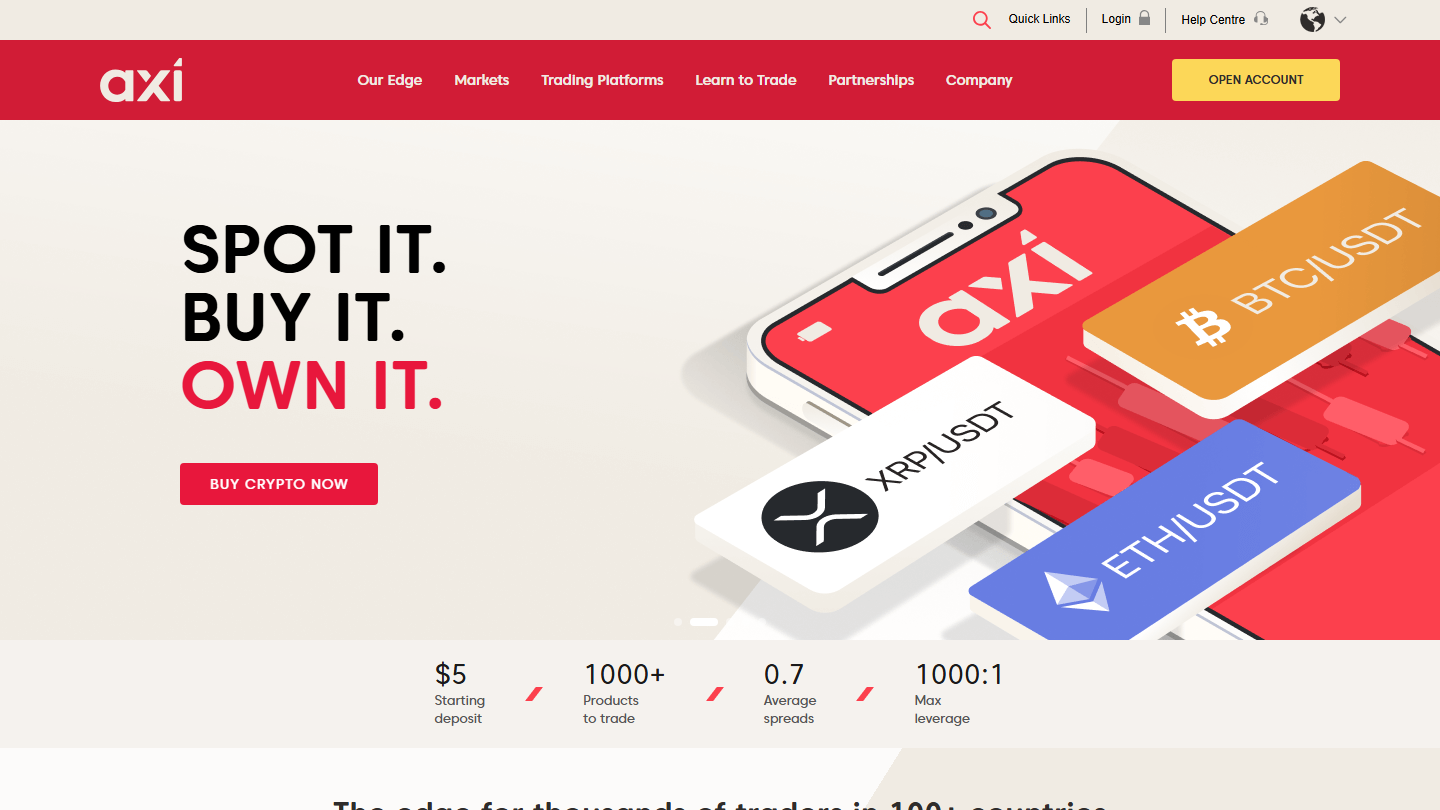
| Minimum deposit | $5 Standard, $500 Pro, $25,000 Elite |
| Spread from | 0.0 pips (Pro and Elite), 0.7 pips average EUR/USD (Standard) |
| Maximum leverage | 1:1000 offshore entity; 1:30 retail under FCA, CySEC and ASIC |
| Instruments | Entity-dependent: 140+ advertised on the UK site, 650+ on the international site |
| Swap-free account | Available on all account types, 140+ eligible instruments |
| Retail loss rate | 72.4% global, 83.1% UK clients, as published when we reviewed in early 2026; not verified at the time of publication |
Pros and cons
We spent four weeks with Axi in January and February 2026. The picture that came out of it is a broker with unusually broad regulatory coverage, competitive costs on its commission-based accounts, and two analysis tools most competitors charge for or do not offer at all. The weaknesses are narrower than the original marketing suggests but they are real, and one of them is Axi’s own inconsistency about how big its product catalogue is.
What works
- Five regulated entities (FCA, ASIC, DFSA, CySEC and FMA), which is broader coverage than most brokers at this size carry.
- Pro account commission is now $4.50 round turn per standard lot, down from $7. That undercuts IC Markets and Pepperstone, both of which still charge $7 on their equivalent accounts.
- Raw spreads on Pro sat between 0.1 and 0.3 pips on EUR/USD through our testing, putting the all-in cost near 0.65 pips.
- PsyQuation and Autochartist are included free from account opening. PsyQuation’s behavioural analysis is genuinely uncommon in this segment.
- No withdrawal or deposit fees charged by Axi on any method we tested.
- Axi Select gives qualifying traders access to firm capital up to $1 million with no subscription fee.
What does not
- The Standard account is the weakest part of the pricing. We measured 1.3 pips on EUR/USD against 0.8 at IC Markets and 1.0 at Pepperstone.
- Axi publishes three different instrument counts across its own sites (140+, 650+ and 1500+) depending on which page you land on. That is a transparency problem, not just a marketing one.
- The Pro account now requires a $500 minimum deposit. It used to require nothing.
- The Dubai branch holds a Category 4 licence and is not permitted to hold client assets or client money, which limits what that licence actually protects.
- Both ASIC and New Zealand’s FMA took action against the Australian entity’s licence between 2019 and 2021. Both matters are resolved, but two regulators reaching for the same licence in two years is a pattern worth knowing about.
- Inactivity costs $10 a month after twelve months without trading.
- Share CFDs only. You never own the underlying stock.
Company information
Axi started in Sydney in 2007 under the name AxiTrader, built by a small group of traders and grown into a group serving clients in more than 100 countries. The core operating entity is AxiCorp Financial Services Pty Ltd (ACN 127 606 348), registered in Australia with its head office in North Sydney. The brand was shortened from AxiTrader to Axi as the business expanded past pure retail forex.
The UK arm came through acquisition rather than organic growth. Axi bought the London brokerage One Financial Markets in 2018, and that entity, now Axi Financial Services (UK) Limited, registered at 1 Finsbury Market, London EC2A 2BN, is what carries the current FCA permission. This matters more than it sounds, and we return to it in the licensing section.
On ownership, our July 2026 check found no change since November 2022, when the company’s management, led by chief executive Rajesh Yohannan, bought control from the Australian investment firm RGT Capital. Axi remains privately held. Headcount sits in the 201 to 500 band, institutional enough to support five regulatory regimes without being a large listed group.
Nineteen years is a long time in this industry. A broker that has run through multiple market dislocations without a solvency event has demonstrated something a two-year-old brand cannot. That is not a guarantee of anything, but it is evidence, and it is more than most of the brokers we cover can point to.
| Item | Detail |
|---|---|
| Operating entity | AxiCorp Financial Services Pty Ltd |
| Registration | ACN 127 606 348 |
| Founded | 2007 |
| Headquarters | North Sydney, NSW, Australia |
| Other offices | London, Dubai (DIFC), Auckland |
| Former brand | AxiTrader |
| Employees | 201–500 |
| Countries served | 100+ |
| Ownership | Management-owned since the November 2022 buyout from RGT Capital |
Who this broker suits (and who it does not)
Axi fits an active trader who will use the Pro account. That is where the pricing is genuinely good and where the $4.50 commission does real work. If you trade a few standard lots a week on majors, the difference between Axi’s Pro pricing and a $7-commission competitor is money you keep. Pro is also the account that puts Axi on our list of the best low spread brokers; Standard would not have qualified.
It also suits traders who want analytics attached to their own behaviour rather than to the chart. PsyQuation reviews your closed trades against a large comparison set and reports what you are doing wrong in specific terms. During our testing it flagged that our losing positions were being held longer on average than our winners: a textbook disposition problem, identified from our own order history rather than from a generic lesson.
It suits you less well if you are starting small. The Standard account has the weakest spreads in Axi’s range and the Pro account now gates entry at $500. A trader depositing $100 gets Axi’s least competitive pricing, which inverts the usual argument for a low-minimum broker.
And it is a poor fit if breadth of market is your priority. Even taking Axi’s most generous published figure, the catalogue is narrower than IC Markets or Pepperstone, and there is no real share dealing; everything equity-linked is a CFD.
Licensing and regulation
This is Axi’s strongest area and also the area where our original research needed correcting. We re-checked every licence against the regulators’ own registers on 27 July 2026.
The UK licence is not the one commonly cited. A great many Axi reviews, including our own earlier work, list FCA firm reference number 509746. That number belongs to AxiCorp Limited, and the FCA register records that firm as no longer authorised since 2 February 2023. The live UK permission sits with Axi Financial Services (UK) Limited under FRN 466201 (the former One Financial Markets entity), and that is the reference number in the footer of Axi’s own UK site. The UK business is properly authorised. The number most people quote for it is dead.
The Australian licence, AFSL 318232, is held by AxiCorp Financial Services Pty Ltd and is active. It carries history. ASIC suspended that licence for four months on 2 January 2020 over the adequacy of its compliance arrangements. Axi took the decision to the Administrative Appeals Tribunal, which stayed the suspension immediately, and on 9 March 2021 the tribunal set the suspension aside by consent. ASIC instead imposed additional conditions on 12 March 2021: an independent expert review, a minimum of three full-time compliance staff, and a bar on appointing corporate authorised representatives, all running to 31 December 2022. Those conditions have expired and the licence carries no current restriction.
New Zealand’s FMA suspended the same entity’s derivatives issuer licence, FSP 518226, in June 2019 for material breaches, and lifted the suspension on 2 December 2021 once it was satisfied the compliance systems had been fixed. That licence is active. Taken together with the ASIC matter, two regulators moved against the same entity inside two years. Both concluded the problems were fixed. A reader deserves both halves of that sentence.
The Dubai branch (AxiCorp Financial Services Pty Ltd operating through its DIFC branch, reference F003742) is active on the DFSA public register, holding a Category 4 licence with a Retail endorsement. A Category 4 firm is not authorised to hold client assets or client money. That is an important qualifier: the licence gives you a regulated counterparty and a complaints route, not custody protection at that entity.
The European entity is Solaris EMEA Ltd, registered in Cyprus as HE376148 and licensed by CySEC under number 433/23. It is active and it is what allows Axi to take clients across the EU and EEA. Outside these regimes, Axi also operates AxiTrader Limited in St Vincent and the Grenadines, which is a company registration rather than a financial licence; that is the entity behind the headline 1:1000 leverage, and it carries none of the compensation-scheme protection the others do.
Warnings on the Axi name
Search for “Axi FCA warning” and you will find three entries, so we should explain them rather than let you find them cold. The FCA has published warnings about “AXI Corp Limited” and “Axitrader FX”, both described as clones of authorised firms, and about “AXI TRADING” operating the domain axitrading.biz, described as an unauthorised firm targeting UK consumers.
None of these is Axi. They are criminals borrowing the name and, in the clone cases, the real firm reference numbers. The FCA’s own clone notice names Axi Financial Services (UK) Limited and AxiCorp Limited as the genuine authorised firms being impersonated. The distinction that matters is the domain: Axi trades at axi.com, and no warning names it. Where a regulator lists a broker’s genuine website as unauthorised, that is a different and far more serious finding. This is not that.
The practical defence is simple. Type the broker’s address yourself, check the firm reference number on the regulator’s register rather than on the firm’s own page, and treat any unsolicited call claiming to be Axi as a scam by default.
| Regulator | Jurisdiction | Reference | Entity | Status at 27 Jul 2026 |
|---|---|---|---|---|
| FCA | United Kingdom | 466201 | Axi Financial Services (UK) Limited | Authorised |
| ASIC | Australia | AFSL 318232 | AxiCorp Financial Services Pty Ltd | Active, conditions expired 2022 |
| DFSA | UAE (DIFC) | F003742 | AxiCorp Financial Services Pty Ltd (DIFC Branch) | Active, Category 4, no client money |
| CySEC | Cyprus | 433/23 | Solaris EMEA Ltd | Active |
| FMA | New Zealand | FSP 518226 | AxiCorp Financial Services Pty Ltd | Active, suspension lifted Dec 2021 |
| None | St Vincent & the Grenadines | 25417 BC 2019 | AxiTrader Limited | Company registration, not a licence |
Which entity you are onboarded to determines what you get. Check it before you deposit, not after.
Opening an account and verification
We opened our account in January 2026. The registration form asks for the usual identifying details, then puts you through a trading-experience and financial-position questionnaire that regulators require. That took about five minutes to complete honestly.
Identity verification was the part we expected to drag and did not. We uploaded a passport and a recent utility bill as proof of address and were approved within one business day. Other traders report longer waits, and the usual cause is document quality: a photograph with a cropped corner or a glare across the data page will send you round again.
Once approved you choose an account type and a base currency. Axi offers USD, EUR, GBP, AUD, CAD, CHF, HKD, JPY, NZD, PLN and SGD. If your bank account is in a currency outside that list, you will pay a conversion cost on every deposit and withdrawal, so it is worth checking before you fund.
A demo account is available immediately without verification, with $50,000 in virtual funds for 30 days. In our testing it tracked live spreads and fill behaviour closely enough to be worth using for platform familiarity, though no demo reproduces the psychology of real money.
Account types
Three retail accounts, and the choice between them is a straightforward cost calculation rather than a question of service level.
The Standard account carries no commission and prices everything into the spread. Axi advertises EUR/USD from 0.7 pips on average; in our own sampling through February 2026 we saw 0.9 to 1.5 pips in normal conditions. It is the simplest structure and the most expensive one for anyone trading with any frequency.
The Pro account is where Axi is competitive. Raw spreads from 0.0 pips, and a commission that has come down to $4.50 round turn per standard lot since our original testing. The entry requirement has moved the other way: Pro now needs a $500 minimum deposit where it previously needed nothing.
The Elite account needs $25,000 and cuts the commission to $3.50 round turn. It is aimed at professional and wholesale clients and adds a named account manager.
| Feature | Standard | Pro | Elite |
|---|---|---|---|
| Minimum deposit | $5 | $500 | $25,000 |
| Spread from | 0.7 pips average | 0.0 pips | 0.0 pips |
| Commission per lot | None | $4.50 round turn | $3.50 round turn |
| Minimum trade size | 0.01 lot | 0.01 lot | 0.01 lot |
| Platforms | Axi platform, MT4, MT5 | MT4, MT5 | MT4, MT5 |
| Swap-free option | Yes | Yes | Yes |
| Dedicated account manager | No | No | Yes |
MAM and PAMM structures are available separately for money managers.
The swap-free account
Axi’s swap-free option removes overnight interest and is available on all three account types. It exists for traders who cannot pay or receive interest for religious reasons, but the mechanics matter to anyone holding positions for days, so it is worth understanding regardless.
More than 140 instruments are eligible, covering major and minor currency pairs, precious metals, some cash indices and a handful of cryptocurrencies. Everything else, share CFDs included, still accrues swap.
The important detail is that swap-free does not mean cost-free. Positions held under five calendar days carry no swap and no holding fee. From the sixth day an administrative holding fee applies, and it varies by instrument, materially higher on metals than on major pairs. If your strategy involves multi-week positions, model that fee before you assume the swap-free account is cheaper.
Two conditions to note. Axi activated swap-free status on our account within one business day of asking. It does not allow you to run a standard account and a swap-free account at the same time, and it reserves the right to monitor swap-free accounts for good-faith use.
Fees and trading costs
Spreads
We sampled spreads across London, New York and Tokyo sessions through February 2026. On the commission-free Standard account Axi sits mid-table: better than XM across the board, consistently wider than IC Markets and Pepperstone.
| Instrument | Axi Standard | IC Markets Standard | Pepperstone Standard | XM Standard |
|---|---|---|---|---|
| EUR/USD | 1.3 pips | 0.8 pips | 1.0 pips | 1.6 pips |
| GBP/USD | 1.8 pips | 1.0 pips | 1.2 pips | 2.1 pips |
| USD/JPY | 1.4 pips | 0.9 pips | 1.1 pips | 1.7 pips |
| AUD/USD | 1.5 pips | 0.9 pips | 1.1 pips | 1.8 pips |
| USD/CHF | 1.6 pips | 1.0 pips | 1.3 pips | 2.0 pips |
| Gold (XAU/USD) | 2.8 pips | 1.5 pips | 1.8 pips | 3.5 pips |
| Oil (WTI) | 3.0 pips | 2.0 pips | 2.5 pips | 3.0 pips |
Measured in February 2026 in normal market conditions on commission-free accounts. Spreads are variable and these figures describe that period, not a guarantee.
The Pro account is a different proposition. Raw spreads on EUR/USD held between 0.1 and 0.3 pips through our sampling. At the $7 commission in force when we tested, the all-in cost worked out at roughly 0.9 pips per standard lot. At the current $4.50 commission (0.45 pips equivalent), the same spread puts the all-in figure closer to 0.65 pips. That is a real improvement and it moves Axi ahead of both IC Markets and Pepperstone on commission, which remain at $7, the figure we recorded again for our Pepperstone review.
Overnight, transfer and inactivity charges
Swap rates move daily with interbank rates and are visible inside MetaTrader before you commit. Wednesday carries a triple charge to cover the weekend, which is standard practice.
Axi charged us nothing on deposits or withdrawals through any method we used. Third parties are a different matter: our bank levied an international transfer fee of $15 to $25 on the wire test, which is the bank’s charge and not Axi’s.
Inactivity costs $10 a month, and only bites after twelve consecutive months with no trading and no open positions. We re-checked this in July 2026 and it is unchanged. Twelve months is generous by industry standards; some competitors start charging after two.
Desktop platforms
Three options: MetaTrader 4, MetaTrader 5, and Axi’s own web platform.
MT4 remains the centre of the offering and Axi supports it properly rather than grudgingly. The build ships with PsyQuation and Autochartist integrated directly, installation was uneventful, and the connection to Axi’s servers stayed stable across every session we tested.
MT5 arrived later and brings depth of market, more timeframes and a wider instrument set. It ran cleanly against Axi’s servers in our testing, but some of the add-ons available on MT4 had not yet been ported across. If a specific tool is the reason you are choosing Axi, confirm it exists on the platform you intend to use.
The Axi Trading Platform runs in the browser with no download. The interface is modern and quick to learn, and it suits traders who want to place orders without a terminal in front of them. It does not have MetaTrader’s depth of charting or its automation, so it is a complement rather than a replacement.
Mobile apps
We traded on mobile through February 2026, testing both the Axi app and the official MT4 app on Android and iOS.
The Axi app covers the full loop: order entry, position monitoring, charting, account management, multiple account switching, demo access, and live chat with support from inside the app. Price alerts work. For most sessions it was responsive, with noticeable lag when opening the shares section.
The weaknesses are visible. The interface looks a generation behind what Capital.com and eToro ship. Mobile charting is thinner than the MetaTrader app’s, so serious chart work still means switching. And identity verification through the app draws recurring complaints in store reviews, which matches the pattern where document photography is the failure point.
The MT4 app works normally against Axi accounts and will feel familiar to anyone who has used it elsewhere. PsyQuation and Autochartist do not appear there.
Trading tools
We placed trades across each asset class to see how the range actually behaves rather than how it is advertised. What we counted in early 2026 was roughly 70 currency pairs, 30 indices, 15 commodities and 100 share CFDs, with a thin crypto selection, around 290 instruments in total.
That figure no longer holds, and Axi’s replacement for it is not one number. Its UK site advertises 140+ products, its international homepage 650+ markets, and its international account page 1500+ CFD products. Those cannot all describe the same catalogue. Some of the gap is genuine (different entities offer different ranges), but not all of it, and a broker publishing three counts of its own inventory is a fair thing to hold against it. We have marked Axi down on transparency for that rather than pretend to a number we cannot reconcile.
What we can report from use: liquidity on the major pairs was excellent, with tight spreads and quick fills. Index spreads on the main contracts were competitive. Gold and oil were reasonable against peers. The equity offering is CFD-only, so you take price exposure without ownership, voting rights or settled dividends. Even on the most generous published count, Axi remains behind IC Markets at 1,700+ and Pepperstone at 1,200+.
| Asset class | Counted early 2026 | Notes |
|---|---|---|
| Currency pairs | 70+ | Majors, minors and exotics |
| Indices | 30+ | US, European and Asian |
| Commodities | 15+ | Metals, energy, agricultural |
| Share CFDs | 100+ | No underlying ownership |
| Cryptocurrencies | Limited | Majors only |
Beyond the instrument list, Axi Select is the standout tool. It is a funded-trading programme with no subscription fee, running six stages from Seed to Pro M, with profit shares from 50% to 90% and allocations up to $1 million of firm capital. Entry requires a $500 deposit, at least 20 closed trades, and an Edge Score of 50 or better. It is a genuine route to trading size you do not have, and it is not a shortcut; the scoring is built to filter.
Order execution
We placed 50 live orders through February 2026 across major pairs, gold and indices, deliberately spread across high and low liquidity periods and through scheduled data releases.
Most orders filled inside one second in normal conditions. Axi runs an STP/ECN model that routes to liquidity providers without a dealing desk, which removes the structural conflict where a broker profits from a client’s loss.
Six of the 50 orders slipped: four against us, two in our favour. A 12% slippage rate with positive slippage present is what honest market execution looks like. A broker showing zero negative slippage across 50 orders would be the finding worth worrying about.
During the February 2026 US non-farm payrolls release, the EUR/USD spread widened from about 0.2 pips to more than 5 pips for several seconds. Every broker does this and none can avoid it. If you trade data releases, size for the spread you will get, not the one on your screen beforehand.
Negative balance protection applies to retail accounts, so a gap cannot put you into debt to the broker. Under FCA, CySEC and ASIC rules this is a legal requirement rather than a favour, and it does not apply in the same way on the offshore entity.
Deposits
We funded the account with $500 by debit card. It took under a minute and the balance appeared in the trading account immediately. We also tested an international bank transfer, which took about two business days to land.
Axi charged nothing on either. Card issuers and intermediary banks may charge their own fees, particularly on international wires, and those are outside the broker’s control.
| Method | Minimum | Processing time | Axi fee |
|---|---|---|---|
| Visa / Mastercard | $5 | Instant | None |
| Bank transfer | No minimum | 1–3 business days | None |
| PayPal | $5 | Instant | None |
| Skrill | $5 | Instant | None |
| Neteller | $5 | Instant | None |
| Crypto (BTC/USDT/ETH) | Varies | Network confirmations | None |
Local payment options vary by country of residence and by the entity holding your account, so the list you see at signup may be shorter or longer than this one.
Withdrawals
Getting money out is the test most reviews skip. We requested a $200 withdrawal back to the debit card on a Tuesday. Axi processed it within one business day and the funds reached the account two days after that: three business days end to end, matching what the broker advertises.
The rule to understand before you deposit is that withdrawals return by the deposit method. Money that came in on a card goes back to that card up to the amount deposited; profits above that come out by bank transfer. This is standard anti-money-laundering practice rather than an obstruction, but it surprises people who deposited by card and expected a wire.
Complete your identity verification before you request anything. Withdrawal requests from partially verified accounts are where delays overwhelmingly originate, and the delay is then attributed to the broker.
In fairness we should note that some traders reported withdrawal delays on public review platforms during 2025. Those reports look like specific cases rather than a pattern, and our own withdrawal ran clean, but we would rather mention them than have you find them and wonder why we did not.
| Method | Processing time | Axi fee | Notes |
|---|---|---|---|
| Visa / Mastercard | 1–3 business days | None | Returns to the depositing card |
| Bank transfer | 1–3 business days | None | Intermediary banks may charge |
| PayPal | 1–2 business days | None | Returns to the same account |
| Skrill | 1–2 business days | None | Returns to the same account |
| Neteller | 1–2 business days | None | Returns to the same account |
| Crypto | Instant to 24 hours | None | Depends on network confirmation |
Customer support
English-language support is available around the clock and it is good. We tested live chat deliberately at an awkward hour (two in the morning) and had a reply in under a minute. The answers were specific and correct rather than deflections to a help article.
Email to [email protected] came back in four to twelve hours depending on the query. Live chat is available on both the website and inside the mobile app, and Axi advertises support in thirteen languages, though coverage outside English is limited to working hours rather than continuous.
What we did not test is telephone escalation on a disputed transaction, which is the scenario where support quality actually matters. Chat responsiveness at 2am is a useful signal but it is not the same test.
Research and education
Axi’s research output is solid without being distinctive: daily technical analysis on the major pairs, an economic calendar built into the platform, in-house commentary, and third-party content from Autochartist. It is pitched at intermediate traders and it is useful at that level.
PsyQuation is the part worth the account. It works as a behavioural coach rather than a market forecaster: it analyses your closed trades, benchmarks them against a large population of other traders, and returns specific corrections. In our testing it identified our asymmetric holding times without being told what to look for. Very few brokers offer anything comparable, and none of the direct competitors we have tested offer it free.
Autochartist runs automated technical analysis into MetaTrader, flagging chart patterns, Fibonacci levels and support and resistance zones. It was available free from account opening. Treat its output as a screening prompt, not a signal to trade.
The Axi Academy runs graded courses from beginner to advanced across trading fundamentals, technical analysis, risk management and trading psychology. The structure is sound and the material is well produced. Regular webinars supplement it.
Fund safety and protections
Four layers decide broker fund safety here, and how much of each you get depends entirely on which entity holds your account.
Segregation. Client funds sit in bank accounts separated from Axi’s operating capital, so they are not available to creditors if the firm fails. This is verifiable through the regulatory filings the FCA and ASIC entities publish.
Compensation schemes. Clients of the UK entity are covered by the FSCS up to £85,000 per person. Clients of the Cypriot entity are covered by the Investor Compensation Fund up to €20,000. Clients of the DIFC branch have neither, because a Category 4 firm does not hold client money in the first place. Clients of the St Vincent entity have no compensation scheme at all.
Negative balance protection. Applies to retail accounts under FCA, CySEC and ASIC. We saw no negative balance event during our testing, including through volatile sessions.
Independent oversight. Tier-one regulation brings periodic audit and direct supervision of capital adequacy and segregation. The 2019 to 2021 ASIC and FMA interventions are evidence that this supervision has teeth, and that Axi has been on the receiving end of it.
The single most consequential decision you make at Axi is which entity you sign up under. A UK client with FSCS cover and a 30:1 leverage cap and an offshore client with 1:1000 leverage and no compensation scheme are using the same brand and buying very different products.
Verdict
Axi scores 8.1 out of 10 on the six-category framework behind all our broker reviews. It is a well-regulated broker with genuinely competitive commission-based pricing, sound execution, and two analysis tools most of its competitors do not match. Its weaknesses are the Standard account’s spreads, a catalogue it cannot describe consistently, and a compliance history that two regulators found wanting before it was fixed.
Two categories moved against the original review this one is built on. Trading costs went up, because the Pro commission has fallen from $7 to $4.50 round turn, which cuts the all-in EUR/USD cost from roughly 0.9 pips to roughly 0.65. Regulation and transparency went down, because the UK firm reference number in the original belongs to an entity the FCA has recorded as no longer authorised since February 2023, because the Dubai branch cannot hold client money, and because Axi’s own sites publish three different instrument counts. The overall figure lands close to where it started, for different underlying reasons. Our weightings are published at how we rate brokers.
| Category | Weight | Score |
|---|---|---|
| Regulation and licensing | 25% | 8.2 |
| Trading costs | 20% | 8.3 |
| Withdrawals and fund access | 20% | 8.0 |
| Platforms and execution | 15% | 8.0 |
| Customer support | 10% | 8.5 |
| Research and transparency | 10% | 7.5 |
| Overall | 100% | 8.1 |
Choose Axi if you will trade the Pro account actively, if you want behavioural analytics on your own order history, or if the funded-trading route through Axi Select appeals. Look elsewhere if you need the widest possible instrument range, if you will only ever fund a small account and be stuck on Standard pricing, or if you want to own shares rather than trade CFDs on them.
Risk. CFDs are leveraged products and most retail accounts lose money trading them. When we reviewed Axi in early 2026 the published figures were 72.4% of retail accounts globally and 83.1% of UK clients; we could not re-verify either figure at the time of publication, so treat them as indicative of scale rather than as current. Nothing in this review is investment advice, and nothing here should be read as suggesting a profit is likely. Do not trade with money you cannot afford to lose.
Is Axi trustworthy?
Is Axi a scam?
No. Axi has operated since 2007 and holds live authorisations from the FCA, ASIC, DFSA, CySEC and New Zealand’s FMA, every one of which we confirmed against the regulators’ own registers on 27 July 2026. Scam operations do not hold tier-one licences for nineteen years and do not survive the kind of supervisory scrutiny Axi has been through. That is not the same as saying every part of the offering is good; it means the fraud question is settled.
Why does the FCA have a warning about Axi?
It has three, and none of them is against Axi. “AXI Corp Limited” and “Axitrader FX” are clone firms: criminals using the real company’s name and firm reference numbers to lend themselves credibility. “AXI TRADING”, operating axitrading.biz, is an unauthorised firm the FCA says is targeting UK consumers. The FCA’s clone notice explicitly identifies Axi Financial Services (UK) Limited as the genuine authorised firm being impersonated. Axi’s real domain, axi.com, appears on no warning list.
Has Axi ever been in trouble with a regulator?
Yes, and it is the fairest criticism in this review. ASIC suspended the Australian licence for four months in January 2020 over compliance arrangements; a tribunal stayed the suspension and set it aside by consent in March 2021, with ASIC imposing extra licence conditions that ran to the end of 2022. New Zealand’s FMA separately suspended the derivatives licence in June 2019 for material breaches and lifted it in December 2021. Both matters are closed, both licences are active and unrestricted, and there is no current enforcement anywhere. But two regulators reaching for the same licence in two years is a real data point, and a reader deciding where to put money is entitled to it.
Can I actually get my money out?
We did. A $200 card withdrawal requested on a Tuesday was processed within one business day and settled in three business days in total, with no fee charged by Axi. The one rule that trips people up is that funds return by the deposit method, so a card deposit comes back to that card before profits are wired.
Which entity will hold my account?
It depends on your country of residence, and it determines your leverage cap, your compensation cover and your complaints route. UK residents go to Axi Financial Services (UK) Limited under FRN 466201, with FSCS cover to £85,000 and 30:1 retail leverage. EU and EEA residents go to Solaris EMEA Ltd under CySEC 433/23, with ICF cover to €20,000. Australians go to AxiCorp Financial Services Pty Ltd under AFSL 318232. Traders offered 1:1000 leverage are being onboarded to the St Vincent entity, which has no compensation scheme. Confirm this in writing before you deposit.
Frequently asked questions
What is the minimum deposit at Axi?
$5 on the Standard account, $500 on Pro, and $25,000 on Elite. The Pro minimum is new; it was $0 when we first tested. Axi Select, the funded-trading programme, requires $500. A deposit large enough to let you size positions sensibly matters far more than clearing any minimum.
What does Axi actually cost to trade?
On Pro, roughly 0.65 pips all-in on EUR/USD at current pricing, about 0.2 pips of spread plus $4.50 round-turn commission per standard lot. On Standard we measured 1.3 pips on EUR/USD with no commission. There are no deposit or withdrawal fees. Inactivity costs $10 a month after twelve months without trading.
Does Axi offer a swap-free account?
Yes, on all three account types, covering more than 140 instruments including major and minor pairs, precious metals, some cash indices and selected cryptocurrencies. Positions held under five calendar days carry no swap and no holding fee. From the sixth day an administrative holding fee applies, and it is materially higher on metals than on currency pairs.
How does Axi compare with IC Markets and Pepperstone?
All three are strongly regulated with comparable raw-spread pricing. Axi now has the commission advantage at $4.50 round turn against $7 at both rivals. IC Markets and Pepperstone have far more instruments: 1,700+ and 1,200+ against Axi’s most generous published figure of 650+. Axi’s differentiators are PsyQuation and the Axi Select funded programme, neither of which the other two match.
What is Axi Select?
A funded-trading programme with no subscription fee, running six stages from Seed to Pro M, with profit shares from 50% to 90% and allocations up to $1 million of Axi’s capital. Qualifying requires a $500 deposit, at least 20 closed trades and an Edge Score of 50 or above. The scoring is designed to filter, so treat qualification as an outcome rather than a plan.
How fast is Axi’s order execution?
Across 50 live orders in February 2026, most filled in under a second in normal conditions. Six slipped (four against us, two in our favour), a 12% rate consistent with genuine market execution. Around the February non-farm payrolls release the EUR/USD spread widened from about 0.2 pips to more than 5 pips for several seconds, which is normal behaviour at a data release and not specific to Axi.
Reader reviews
Traded with this broker? Tell others what actually happened.