
BlackBull Markets is a New Zealand ECN/STP broker that puts MetaTrader 4, MetaTrader 5, cTrader and TradingView on a single account and quotes more than 26,000 instruments across them. That platform range is genuinely unusual, and the pricing on its raw-spread account is competitive. The complication is structural: the entity holding the respected New Zealand licence serves New Zealand, and almost everyone else is onboarded offshore.
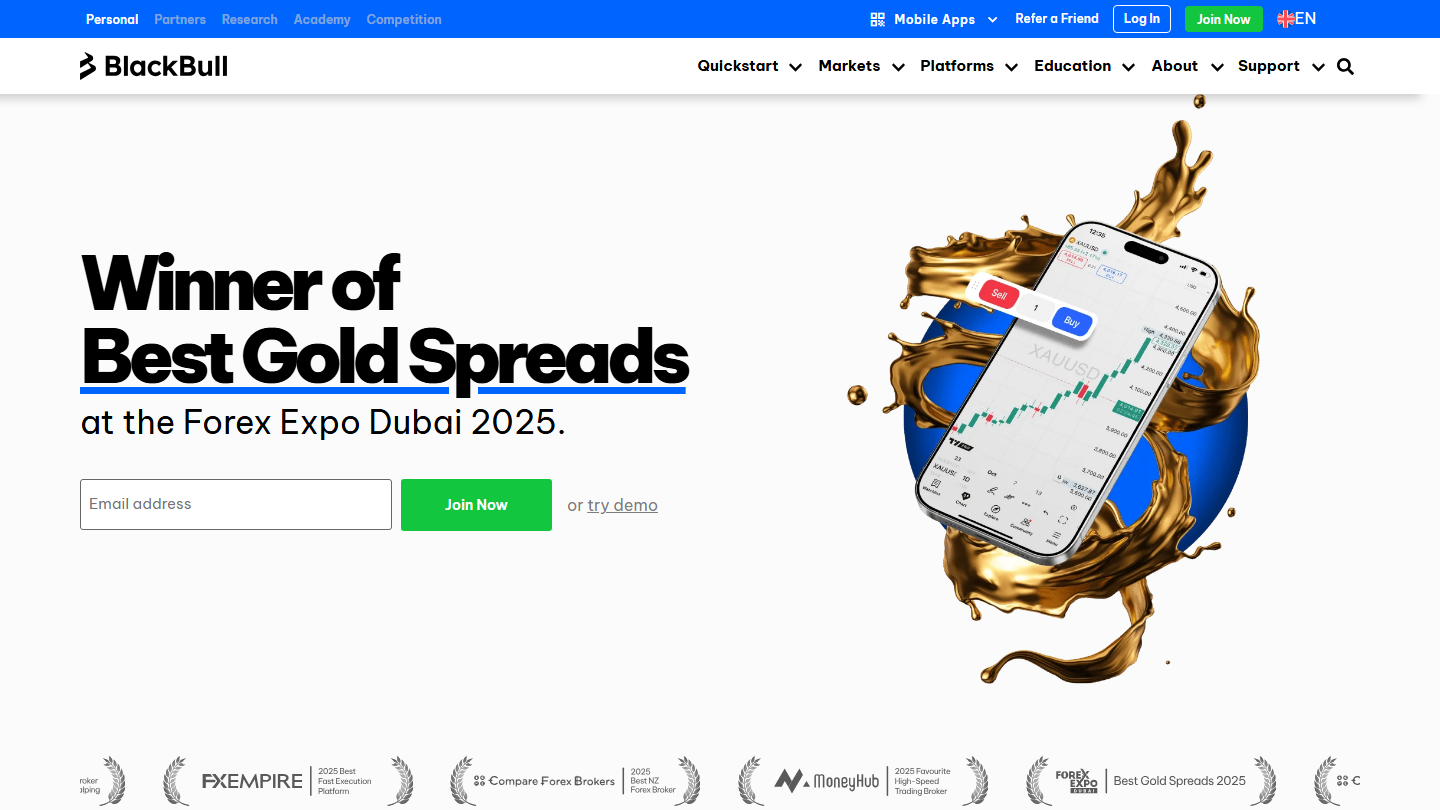
We opened a live ECN Prime account, funded it, placed more than 40 trades across major currency pairs and gold, tested each platform, contacted support on three channels and ran a full withdrawal cycle. Everything measured below comes from that testing in February and March 2026, re-verified against the regulators’ own registers and the broker’s published schedules on 27 July 2026.
Disclosure: we may earn a commission if you open an account through links on this page. It does not affect our ratings, our rankings, or what we write; the scoring rubric is fixed before testing begins. Read how we make money.
| Overall rating | 7.1 / 10 |
|---|---|
| Founded | 2014 |
| Headquarters | Auckland, New Zealand |
| Licences | FMA New Zealand (FSP403326); FSA Seychelles (SD045) |
| Minimum deposit | $0 (ECN Standard and ECN Prime) |
| Spreads from | 0.0 pips (ECN Prime) |
| Maximum leverage | 1:500 |
| Instruments | 26,000+ |
| Swap-free option | Available on all account types |
| Retail loss rate | 74–89% of retail accounts lose money |
Pros and cons
Four weeks of testing produced a split verdict. BlackBull is a strong technical product wrapped in a regulatory structure that is weaker than its marketing implies.
What works
- MT4, MT5, cTrader and TradingView all available on one account; very few brokers offer all four, and switching between them required no new account
- Free TradingView Essential, Plus or Premium for active traders, with orders routed through BlackBull directly from the chart
- Raw spreads averaging 0.16 pips on EUR/USD on ECN Prime when we sampled during London and New York hours, giving roughly 0.76 pips all-in once commission is counted
- 26,000+ instruments, far more than IC Markets, Pepperstone or Eightcap offer, driven by a very deep share CFD list
- No minimum deposit on ECN Standard or ECN Prime, so the account can be tested with a small balance
- A real, verifiable New Zealand FMA derivatives issuer licence with segregated client money and access to an independent dispute-resolution scheme
- No sales pressure after registration: no broker called us, which is rarer than it should be
What does not
- UK, EU, US, Canadian and Indian residents are not accepted at all; for a large share of readers this review ends at eligibility
- Australian clients are onboarded to the Seychelles entity, not an ASIC-regulated one, so the FMA licence is not what governs their account
- No investor compensation scheme on either entity, nothing equivalent to the FSCS or the Cypriot ICF if the firm fails
- A $5 withdrawal fee on every withdrawal regardless of size or method, where IC Markets, Pepperstone and Eightcap charge nothing
- Negative balance protection is applied in practice but is not clearly written into the client agreement as a binding commitment
- Educational content is thin: there is no structured academy comparable to the better-resourced competitors
- An active and growing set of imposter websites trading on the BlackBull name, flagged by the FMA and updated as recently as May 2026
Company information
BlackBull Markets is the trading name of Black Bull Group Limited, founded in Auckland in 2014 by Michael Walker and Selwyn Loekman. The New Zealand company number is 5463921 and the registered office is at Level 20, 188 Quay Street, Auckland 1010. International clients contract instead with BBG Limited, a Seychelles company registered as 857010-1.
The firm is mid-sized rather than large. It employed roughly 92 people at the time of our research and serves clients across more than 180 countries. That is a fraction of the headcount at IC Markets or Pepperstone, and it shows in the depth of the educational and research output rather than in the trading infrastructure, which is well built.
Ownership is worth understanding, because it is the strongest single signal of institutional durability here. Milford Asset Management, a New Zealand and Australian manager running more than NZ$17.5bn, took a minority position through its Private Equity Fund III and holds roughly 20.6%. LMAX Group, the London institutional FX and crypto exchange operator, acquired a stake of approximately 20.8% in June 2024 as part of a pricing and liquidity partnership. The two co-founders retain roughly 30% each. Two institutional investors of that calibre conducting diligence and taking board representation is meaningful (few of the brokers we cover have it), and it is a point the broker’s own marketing undersells.
In March 2026 the company launched a non-deal roadshow for a proposed dual listing on the ASX and NZX, presenting NZ$108m of trailing revenue, NZ$55m EBITDA and NZ$38m net profit, with Barrenjoey, UBS and Forsyth Barr mandated. As of late July 2026 the listing had been reported as delayed and had not priced; the company remains privately held. A float would eventually bring audited public reporting, which would be a transparency gain, but nothing has changed yet.
| Item | Detail |
|---|---|
| Legal name (NZ) | Black Bull Group Limited |
| Legal name (international) | BBG Limited (Seychelles, 857010-1) |
| Founded | 2014 |
| Founders | Michael Walker, Selwyn Loekman |
| NZ company number | 5463921 |
| Employees | Approximately 92 |
| Markets served | 180+ countries |
| Institutional shareholders | LMAX Group (~20.8%), Milford PE Fund III (~20.6%) |
Who this broker suits (and who it does not)
Start with eligibility, because it disqualifies more readers than any other factor. BlackBull does not accept retail clients resident in the United Kingdom, the European Union, the United States, Canada or India. If you live in any of those, nothing else in this review applies to you.
For everyone else (Australia, New Zealand, most of Asia, Latin America, Africa and a long tail of smaller markets), the account is available, but which entity you get matters. New Zealand residents contract with the FMA-licensed entity. Everyone else, Australians included, contracts with BBG Limited in Seychelles.
The broker suits an experienced, self-directed trader who values execution quality and platform choice and who is capable of assessing counterparty risk without leaning on a compensation scheme. If you already work in TradingView and want to trade from your charts without a third-party bridge, BlackBull is one of the cleanest routes available. Algorithmic traders get FIX API and VPS access at the institutional tier. High-volume traders get commissions that are negotiable at the top account level.
It does not suit a beginner who wants to be taught. The education library is thin and there is no structured curriculum. It also does not suit anyone whose primary decision criterion is regulatory protection: a trader who wants a tier-one licence, a statutory compensation scheme and a national ombudsman is better served by an FCA, ASIC or CySEC-regulated firm. That is a legitimate preference and BlackBull cannot satisfy it for most of its client base.
Licensing and regulation
This is the weakest part of the proposition and the category that sets the overall score. We verified both licences directly against the regulators’ registers on 27 July 2026.
| Regulator | Jurisdiction | Licence | Tier | Status |
|---|---|---|---|---|
| Financial Markets Authority | New Zealand | FSP403326 | Tier two | Active, granted 12 Aug 2020 |
| Financial Services Authority | Seychelles | SD045 | Tier three (offshore) | Active |
The New Zealand licence is real and current. Black Bull Group Limited appears on the FMA’s licensed provider register as a Derivatives Issuer under FSP403326, licence status active, granted 12 August 2020. The FMA requires client money to be held in segregated trust accounts, imposes annual audit and anti-money-laundering obligations, and the firm belongs to Financial Services Complaints Limited, an independent dispute-resolution scheme. Client funds are held at ANZ Bank New Zealand. This is a credible regime, just not a tier-one one, and it lacks the compensation backstop that FCA and CySEC authorisation carries.
The decisive point is scope. That licence governs the New Zealand entity. Everyone onboarded outside New Zealand contracts with BBG Limited under Seychelles FSA licence SD045, an offshore regime with materially lighter capital, conduct and reporting requirements. Australian traders should read this carefully: BlackBull accepts Australian clients but holds no ASIC licence, so an Australian account is a Seychelles account and AFCA is not available to it. The 1:500 leverage the broker advertises exists precisely because the offshore entity is not bound by the 1:30 retail caps the FCA and ASIC impose.
Neither entity participates in an investor compensation scheme. There is no equivalent of the UK’s FSCS at £85,000 or the Cypriot ICF at €20,000. If the firm fails, segregation of client money and the company’s own solvency are the whole of your protection. Against direct competitors the gap is clear: IC Markets holds ASIC and CySEC authorisations, Pepperstone holds FCA, ASIC, CySEC and DFSA, and Eightcap holds ASIC, FCA and CySEC.
The imposter websites, and a warning that does not exist
The FMA maintains an active alert titled Blackbull Markets – Imposter websites, first published in September 2024 and still being updated; entries were refreshed in February, May and again on 21 May 2026. It warns about third-party sites misusing Black Bull Group Limited’s New Zealand registration details, and records the broker’s confirmation that it is not associated with them.
This is a warning about the brand, not against the broker, but it is a live risk to readers because the fakes are proliferating. Domains named by the FMA include blackbull-markets.net, blackbullsgroup.net, blackbullsgroup.top, blackbull-group.top, bullxmarket.com and .net, bullxtrade.com, exaitrade.com, solidbulltrades.com, swissxmarket.com and zerofx.trade, with alleged office addresses in Auckland, Mahé, Sofia and Dubai. The genuine site is blackbull.com and it is not on that list. Check the domain character by character before depositing anywhere; it is the first step in any broker scam check.
Readers searching for this broker will also find confident claims that the FCA published a warning against BlackBull Markets in April 2026. We checked: the cited FCA page returns a 404, an FCA site search for “blackbull” returns no results, and a search for the exact phrase “Black Bull Group” returns one unrelated firm from 2010. The FCA’s index is current (it returns warnings published in March 2026 and pages modified in July 2026), so this is not a stale-index artefact. There is no FCA warning against this broker. That is consistent with the fact that BlackBull does not solicit UK clients in the first place. We record it because the false claim ranks well and deserves an answer.
Opening an account and verification
Registration took about 10 minutes when we opened our account in February 2026, slightly longer than the industry norm because the suitability questionnaire is more detailed than most. The form covers personal details, then trading experience, income source and investment objectives, then account type, platform and base currency.
Verification was quick. We uploaded a passport and a recent utility bill in the client portal, which accepts JPG, PNG and PDF, and the account was approved within one business day. That is at the fast end of what we see.
The most notable thing about onboarding was what did not happen. No account manager called, and no one pressed us to fund beyond the minimum. Communication was limited to confirmation emails and platform instructions. Given how routinely this industry treats a new registration as a lead to be worked, the restraint is worth crediting.
Nine base currencies are available: USD, EUR, GBP, JPY, AUD, NZD, SGD, CAD and ZAR. If you bank outside those nine, expect a conversion cost on every deposit and withdrawal levied by your bank or payment provider rather than by the broker. A free demo account is available, and we would use it for a fortnight before funding, mainly to confirm that execution behaves the way you need it to on your own strategy.
Account types
Three live account types, plus a demo and a swap-free option available across all three.
| Feature | ECN Standard | ECN Prime | ECN Institutional |
|---|---|---|---|
| Minimum deposit | $0 | $0 | $20,000 |
| Spreads from | 0.8 pips | 0.0 pips | 0.0 pips |
| Commission per lot (round turn) | None | $6 | $4, negotiable |
| Maximum leverage | 1:500 | 1:500 | 1:500 |
| Platforms | MT4, MT5, cTrader, TradingView | MT4, MT5, cTrader, TradingView | All four, plus FIX API |
| Swap-free option | Yes | Yes | Yes |
| Free VPS | No | No | Yes |
ECN Standard bundles the cost into the spread, which ran between 0.8 and 1.2 pips on EUR/USD in our sampling during London and New York hours. It is a reasonable default for someone trading infrequently who would rather not think about commission.
ECN Prime is the better value for anyone trading with any regularity, and it is the account we used for the bulk of testing. Raw spreads plus $6 per standard lot round turn produced an all-in cost of roughly 0.76 pips on EUR/USD. ECN Institutional drops commission to $4 and makes it negotiable, and adds FIX API and a free VPS, but the $20,000 entry restricts it to a narrow group.
One structural detail that is easy to miss: instrument coverage varies sharply by platform, not by account. MT4 exposes roughly 311 instruments, MT5 around 2,500, and TradingView the widest selection. The headline 26,000+ figure is not reachable from every platform, so pick the platform that carries what you actually intend to trade.
Swap-free accounts
A swap-free option is available on all three account types, so traders who cannot hold interest-bearing positions, whether for religious reasons or because a strategy requires predictable overnight costs, keep the same spreads, commissions and platform access as everyone else. That is better than the common approach of restricting swap-free status to a single, worse-priced account.
The mechanics matter. You open a standard MT4 or MT5 account first and then request conversion through customer service; approval is discretionary rather than automatic and documentation is sometimes requested. Swap charges are replaced by an administration fee that varies by instrument, position size and holding period. On some instruments, over some holding periods, that fee can exceed what the ordinary swap would have cost. Model it against your actual holding periods before converting rather than assuming it is cheaper. There is no additional minimum deposit. BlackBull does not name an independent scholarly board supervising the structure, which is worth knowing if that assurance matters to you.
Fees and trading costs
We sampled spreads repeatedly through February 2026 on ECN Prime during London and New York hours and compared them against the equivalent raw-spread accounts at three competitors. Figures are averages in pips.
| Instrument | BlackBull Prime | IC Markets Raw | Pepperstone Razor | Eightcap Raw |
|---|---|---|---|---|
| EUR/USD | 0.16 | 0.02 | 0.10 | 0.06 |
| GBP/USD | 0.30 | 0.23 | 0.27 | 0.25 |
| USD/JPY | 0.20 | 0.15 | 0.16 | 0.14 |
| AUD/USD | 0.25 | 0.03 | 0.17 | 0.27 |
| USD/CHF | 0.40 | 0.35 | 0.32 | 0.38 |
| Gold (XAU/USD) | 0.12 | 0.08 | 0.10 | 0.15 |
| Oil (WTI) | 0.04 | 0.03 | 0.03 | 0.04 |
BlackBull is competitive without leading. IC Markets was tighter on most pairs in our sampling, sometimes substantially: 0.02 against 0.16 on EUR/USD is a real difference for a high-frequency strategy. Gold at 0.12 was the standout, beating Eightcap and close to Pepperstone. The spread reduction BlackBull made in 2025 clearly narrowed the gap.
Spreads widened noticeably in thin liquidity. During the Asian session and around scheduled economic releases, EUR/USD moved from 0.16 to 0.5 pips or wider. That is expected behaviour in a genuine ECN environment and is evidence the broker passes through raw pricing rather than smoothing it, but it means quoted averages describe active hours, not all hours.
On commission, $6 per standard lot round turn on ECN Prime sits mid-market: IC Markets charges $6 to $7 depending on platform, Eightcap $7, and our Pepperstone review recorded $7 on Razor. All-in on EUR/USD, BlackBull’s roughly 0.76 pips compares with about 0.62 at IC Markets on cTrader and roughly 0.76 at Eightcap.
Two costs deserve more attention than the spread table. Overnight swap rates ran above the sector average on several pairs, which compounds against position traders holding for weeks; Wednesday carries a triple charge to cover the weekend. And the $5 withdrawal fee, covered in full below, is the single clearest cost disadvantage against the comparison set. An inactivity fee of $10 per month after 12 dormant months exists in the terms; support told us in February 2026 that it had never been applied to a client, which is better than the policy reads but is a discretion rather than a guarantee.
Desktop platforms
Platform range is BlackBull’s strongest card. MetaTrader 4, MetaTrader 5, cTrader and TradingView are all available, all from a single account, and we moved between them during testing without opening anything new.
MT4 remains the narrowest in instrument terms at roughly 311 symbols, but it is still the right choice if your workflow depends on an existing Expert Advisor or the mature indicator ecosystem. MT5 opens up around 2,500 instruments, adds 38 further built-in indicators and handles equities properly; it ran smoothly and filled orders quickly throughout our testing.
cTrader was the pleasant surprise. The interface is cleaner and more modern than either MetaTrader build, depth-of-market data is better presented, and charting feels more fluid. cTrader Copy, added in 2025, allows strategy copying without leaving the platform.
The TradingView integration is the most commercially interesting piece. BlackBull provides free TradingView Essential, Plus or Premium subscriptions to active traders, and orders route to BlackBull directly from the chart. If TradingView is already where you do your analysis, this removes a whole layer of friction and represents real monetary value: those subscriptions are not cheap.
Mobile apps
BlackBull leans on the standard MT4, MT5 and cTrader mobile apps for trading, all connecting to its servers on Android and iOS. Execution speed from mobile was good in our testing and we saw no meaningful divergence from desktop under normal market conditions. The cTrader app is the most visually coherent of the three.
Alongside those, the broker publishes its own apps. The BlackBull client portal handles balances, deposits, withdrawals and account settings in a plain, functional interface. BlackBull CopyTrader handles strategy copying from a phone, and BlackBull Invest targets longer-horizon share investing.
The overall mobile experience is solid rather than exceptional. Spreading functionality across several apps means account management and copy trading live somewhere other than your charts, which is more switching than a single well-built app would demand. On public sentiment, BlackBull holds a 4.8 out of 5 Trustpilot score across more than 2,600 reviews, with 91% at five stars and 4% at one star. That is a strong distribution, though the negative tail centres on withdrawal delays, which is the pattern worth watching at any broker.
Trading tools
The instrument catalogue is the broadest of any broker in our comparison set, and by a wide margin.
| Asset class | Approximate count | Examples |
|---|---|---|
| Forex pairs | 70 | Majors, minors and exotics |
| Share CFDs | 26,000+ | US, European and Asian equities |
| Indices | 15 | S&P 500, NASDAQ, DAX, FTSE |
| Commodities | 21 | Gold, silver, oil, natural gas, wheat |
| Cryptocurrencies | 22 | Bitcoin, Ethereum, Ripple |
For context, IC Markets offers roughly 2,200 instruments, Pepperstone around 1,200 and Eightcap about 800. Nearly all of BlackBull’s advantage sits in share CFDs: thousands of individual equities against a few hundred elsewhere. If you want to trade forex and single stocks from one balance, this is a genuine differentiator. If you only trade majors and gold, it is a number on a page.
Copy trading is unusually well covered, with four routes: ZuluTrade, Myfxbook, BlackBull CopyTrader and cTrader Copy. Leverage varies by asset class, up to 1:500 on forex and precious metals, 1:100 on indices and WTI, 1:5 on shares, and between 1:4 and 1:100 on crypto.
Treat that 1:500 headline as a risk indicator, not a feature. Leverage scales losses exactly as fast as gains, and it is available at this level only because the offshore entity is not bound by the retail caps tier-one regulators impose. Between 74% and 89% of retail accounts lose money trading CFDs with this broker, on its own published figures. CFDs are complex instruments and most retail clients lose money on them; never trade with money you cannot afford to lose.
Order execution
We placed more than 40 live trades across major pairs and gold in February 2026 to assess execution, and the results were good.
BlackBull runs an ECN/STP model, routing orders to institutional liquidity providers rather than internalising them on a dealing desk. The structural benefit is the absence of a direct conflict between the broker’s book and the client’s position.
Market orders filled in under a second in most cases during active London and New York hours. Slippage was small and, importantly, roughly symmetric; we recorded positive and negative slippage at comparable rates, which is the signature of a fair execution environment rather than one skewed against the client. Asymmetric slippage is the thing to look for, and we did not find it here.
Pending limit and stop orders executed accurately at their specified levels under normal conditions. We saw slippage on stop orders during sharp volatility around the US employment release, which is expected in any genuine ECN environment and is not evidence of poor practice. Institutional clients can access FIX API and a free VPS to reduce latency for automated strategies.
Overall, execution quality was close to what we have measured at IC Markets and Pepperstone. For discretionary manual trading the difference is not perceptible; for scalping or high-frequency approaches, the wider average spread rather than the execution mechanism is what would cost you.
Deposits
We funded by debit card and the balance appeared in under five minutes. BlackBull charges nothing on any deposit method.
| Method | Minimum | Fee | Processing time |
|---|---|---|---|
| Bank transfer | $1 | Free | 1–3 business days |
| Credit or debit card | $25–50 | Free | Instant |
| Skrill | $25 | Free | Instant |
| Neteller | $25 | Free | Instant |
| Cryptocurrency | $25–50 | Free | Network dependent |
The method list is conventional: bank transfer, cards, two major e-wallets and crypto. There is no local payment rail support of the kind some regional competitors provide, so international bank transfers and card payments do the work. Deposits are free from the broker’s side, but your own bank or payment provider may levy international transfer or currency conversion charges, particularly if your account currency is not one of the nine supported.
Withdrawals
We submitted a bank transfer withdrawal on a business day in February 2026. BlackBull processed the request within 24 hours and the funds reached our bank account four business days later. The process was orderly and we met no obstruction, no retention call and no unexplained documentation request.
| Method | Fee | Processing time | Minimum |
|---|---|---|---|
| Bank transfer | $5 | 3–5 business days | $50 |
| Credit or debit card | $5 | 1–3 business days | $50 |
| Skrill | $5 | 1–3 business days | $50 |
| Neteller | $5 | 1–3 business days | $50 |
| Cryptocurrency | $5 plus network fee | Network dependent | $50 |
The $5 flat fee on every withdrawal, whatever the amount and whatever the method, is the clearest cost weakness in the account. IC Markets, Pepperstone and Eightcap all process standard withdrawals free. Withdraw monthly and that is $60 a year for a service competitors give away; withdraw weekly and it becomes a meaningful drag on a small account. The rational response is to batch withdrawals rather than take frequent small ones, but having to plan around a fee is itself the criticism.
Anti-money-laundering rules require funds to return to the original funding source up to the amount deposited; profits above that can be directed to another account in your own name. This is standard and not a red flag. Some forum reports describe delayed withdrawals; we did not experience this, and in our testing the process worked as documented. Incomplete verification documents or additional compliance review are the usual causes of delay at any broker, so complete KYC properly at onboarding rather than at the point you want your money.
Customer support
We tested support across three channels. Live chat, available 24/6, answered in under 30 seconds, and the agent was technically competent: questions about account types, commission structure and the swap-free administration fee got specific answers rather than deflection to a help page. Email produced a detailed reply in about four hours. Phone support runs 24/5 and WhatsApp is available during business hours.
| Channel | Availability | Response time in testing |
|---|---|---|
| Live chat | 24/6 | Under 30 seconds |
| 24/7 intake | 2–6 hours | |
| Phone | 24/5 | Immediate |
| Business hours | Variable |
Support is offered in English plus a range of European and Asian languages. The main structural gap is that live chat is 24/6 rather than 24/7, so a problem arising during the Sunday market open has to wait. Quality of answer was the strongest aspect: we were not routed to a salesperson, and the technical questions were handled by someone who understood the product.
Research and education
Research and education are not equally resourced here, and the gap is wide.
Research is a genuine strength. BlackBull acquired ATM Strategy, a specialist research firm, and the effect is visible in the daily Trading Opportunities pieces, which offer specific technical reasoning rather than recycled market summary. Myfxbook research is integrated into the platform, and there is a functional economic calendar alongside risk-management and position-size calculators.
Education is thin. There is no structured academy of the kind several competitors maintain, and what exists covers introductory ground without building into a curriculum. For a broker whose offshore entity offers 1:500 leverage to retail clients, a serious risk-education programme would be the appropriate accompaniment, and its absence is a fair criticism. An experienced trader will not miss it. A newer trader should get their grounding elsewhere before funding an account here.
On transparency, the picture is mixed. Pricing, commissions and the withdrawal fee are all disclosed clearly, and the retail loss rate is published. Against that, negative balance protection is applied in practice but not written into the client agreement as a binding commitment, and the entity structure, which determines whether your account sits under FMA or Seychelles oversight, takes more digging than it should.
Fund safety and protections
Client money is held in segregated accounts, separate from the firm’s operating funds, at ANZ Bank New Zealand for the New Zealand entity. Segregation is mandated and supervised under the FMA licence. For the Seychelles entity, segregation is stated policy but the supervisory intensity behind it is materially lower, and that distinction matters because most clients are on the Seychelles entity.
Negative balance protection is provided on both entities: statutory on the FMA-regulated entity, and as a matter of broker policy on the Seychelles side. We found no evidence of it failing. The criticism is documentary rather than practical: a protection delivered by policy can be amended by policy, and one written into the client agreement cannot.
There is no investor compensation scheme on either entity. This is the single most important limitation on this page. If BlackBull became insolvent, there is no FSCS, no ICF and no equivalent fund standing behind client balances; recovery would depend on segregation having been properly maintained, which leaves broker fund safety here resting on one layer rather than two. The FSCL dispute-resolution scheme provides independent adjudication of complaints, but it applies principally to the New Zealand entity and it resolves disputes; it does not compensate for failure.
| Protection | BlackBull | IC Markets | Pepperstone |
|---|---|---|---|
| Segregated client funds | Yes | Yes | Yes |
| Negative balance protection | Yes, policy-based offshore | Yes | Yes |
| Investor compensation scheme | No | Yes (ICF, to €20,000) | Yes (FSCS, to £85,000) |
| Dispute resolution | FSCL (New Zealand entity) | AFCA (Australia) | FOS (United Kingdom) |
| Tier-one licence | No | Yes (ASIC, CySEC) | Yes (FCA, ASIC, CySEC) |
The counterweight is institutional. Two substantial investors, LMAX Group and Milford, conducted diligence and took equity, and the firm has traded for more than a decade with disclosed revenue of NZ$108m and net profit of NZ$38m. That is a meaningful solvency signal. It is not a substitute for a compensation scheme, and it should not be read as one.
Verdict
BlackBull Markets scores 7.1 out of 10 on the six-category framework behind all our broker reviews. It is a well-built trading operation with a regulatory structure that does not match it.
What we measured was consistently good. Execution was fast and slippage was symmetric across more than 40 trades. Four platforms on one account, with TradingView subscriptions included, is a combination almost no competitor matches. Pricing is competitive on ECN Prime and excellent on gold. Support answered quickly and knew the product. The withdrawal we requested was processed within a day and paid without friction.
The limits are structural rather than operational. Most clients are onboarded offshore in Seychelles, neither entity carries an investor compensation scheme, and the $5 withdrawal fee is a recurring cost competitors do not charge. Education is thin for a broker offering 1:500 leverage. None of that is fraud or misconduct; it is a specific set of trade-offs, and whether they are acceptable depends on what you are optimising for.
Our score comes from six weighted categories, and it is lower than the rating this broker carried in our earlier Arabic-language assessment. The category that moved is regulation and licensing. Under this rubric it carries 25% of the total, and for a readership concentrated in the UK, Europe and Australia the honest position is that the FMA licence largely does not apply: UK and EU readers cannot open an account, and Australian clients are onboarded offshore with no ASIC cover and no access to AFCA. Customer support scored considerably higher here than in the original (the language-support penalty that applied to that audience is not part of this rubric), but at 10% it could not offset the regulatory weighting. Read our full rating methodology.
| Category | Weight | Score |
|---|---|---|
| Regulation and licensing | 25% | 5.5 |
| Trading costs | 20% | 7.5 |
| Withdrawals and fund access | 20% | 6.8 |
| Platforms and execution | 15% | 9.0 |
| Customer support | 10% | 8.5 |
| Research and transparency | 10% | 6.5 |
| Overall | 100% | 7.1 |
Consider BlackBull if you are an experienced trader outside the restricted countries who wants platform flexibility, deep instrument coverage and honest ECN execution, and who can assess counterparty risk without a compensation scheme underneath. Look elsewhere if regulatory protection is your first criterion (IC Markets and Pepperstone hold tier-one licences and charge nothing to withdraw), or if you are early enough in your trading that you need to be taught rather than merely served.
Whichever you choose, trade on the assumption that you may lose. Between 74% and 89% of retail accounts lose money with this broker on its own published figures, CFDs are complex leveraged instruments, and nothing in this review should be read as advice to trade or as any suggestion of profit.
Is BlackBull Markets trustworthy?
Is BlackBull Markets a scam?
No. Black Bull Group Limited has been registered in New Zealand since 2014 and holds an active FMA derivatives issuer licence, FSP403326, verifiable on the regulator’s own register. It carries institutional shareholders in LMAX Group and Milford Asset Management, discloses NZ$108m of revenue, and paid our withdrawal without obstruction. The important caution is different: the FMA has flagged a growing set of imposter websites misusing BlackBull’s registration details, and depositing with one of those is a real risk. The genuine site is blackbull.com.
Has the FCA issued a warning against BlackBull Markets?
No. Several review sites claim an FCA warning was published in April 2026 naming blackbull.com. We checked the FCA directly in July 2026: the page those sites cite returns a 404, a site search for “blackbull” returns nothing, and a search for “Black Bull Group” returns only an unrelated firm from 2010, on an index that is current to within days. No such warning exists. BlackBull does not accept UK clients, so there is no UK solicitation for the FCA to act against. What does exist is the New Zealand FMA’s imposter-websites alert, which is about criminals using the brand rather than about the broker.
Which entity will hold my account, and does the FMA licence protect me?
Only if you are in New Zealand. New Zealand residents contract with Black Bull Group Limited under the FMA licence. Everyone else is onboarded to BBG Limited in Seychelles under FSA licence SD045, an offshore regime with lighter requirements. Australian traders in particular should note that BlackBull accepts them but holds no ASIC licence, so AFCA is not available. UK, EU, US, Canadian and Indian residents are not accepted at all.
What happens to my money if BlackBull fails?
Client funds are held in segregated accounts, which should keep them separate from creditors’ claims, but neither entity belongs to an investor compensation scheme. There is no FSCS or ICF equivalent, so if segregation were not properly maintained there is no fund to make you whole. This is the most significant limitation of trading here and it is why regulation scores 5.5 in our rubric.
Are there withdrawal problems?
We did not encounter any. Our request was processed within 24 hours and the money arrived four business days later. Some forum reports describe delays, and a minority of Trustpilot reviews raise the same theme, though the overall score is 4.8 across more than 2,600 reviews. The predictable cost is not delay but the $5 fee charged on every withdrawal regardless of size.
Frequently asked questions
What is the minimum deposit at BlackBull Markets?
There is no minimum on ECN Standard or ECN Prime, so you can fund with whatever you choose. ECN Institutional requires $20,000. In practice, individual payment methods impose their own floors of roughly $25 to $50 for cards, e-wallets and crypto, while bank transfer starts at $1.
Which platforms does BlackBull Markets offer?
MetaTrader 4, MetaTrader 5, cTrader and TradingView, all accessible from a single account on desktop and mobile. FIX API is available on Institutional accounts, and the broker publishes its own client portal, CopyTrader and Invest apps. Note that instrument coverage differs by platform: MT4 carries around 311 symbols, MT5 about 2,500, and TradingView the widest range.
How much does it cost to withdraw?
A flat $5 per withdrawal, regardless of amount or method, with crypto withdrawals also carrying the network fee. The minimum withdrawal is $50 and processing took one to five business days depending on method when we tested. Third-party bank or payment provider charges may apply on top.
Does BlackBull Markets offer swap-free accounts?
Yes, on all three account types, with no change to spreads, commissions or platform access. You open a standard MT4 or MT5 account and then request conversion through customer service; approval is discretionary and may require documentation. Swap charges are replaced by an administration fee that varies by instrument and holding period and can exceed the ordinary swap in some cases, so check it against your own holding periods first.
What leverage is available, and is it safe?
Up to 1:500 on forex and precious metals, 1:100 on indices and WTI, 1:5 on shares and between 1:4 and 1:100 on crypto. That maximum is available because the Seychelles entity is not bound by the 1:30 retail caps applied by tier-one regulators, and it is a risk marker rather than a benefit. High leverage magnifies losses at exactly the rate it magnifies gains, and most retail accounts trading CFDs lose money.
How does BlackBull compare with IC Markets and Pepperstone?
BlackBull wins decisively on platform choice and instrument range, and its gold spreads were competitive in our sampling. IC Markets was tighter on most currency pairs and charges nothing to withdraw. Pepperstone holds FCA, ASIC, CySEC and DFSA authorisations and also withdraws free. If regulatory protection and pure forex cost dominate your decision, the competitors lead; if platform flexibility and breadth of market access matter more, BlackBull has the better product.
Reader reviews
Traded with this broker? Tell others what actually happened.