
The most important fact about FXCM is not on its website. In 2017 US regulators found the firm had concealed its relationship with its main market maker while telling clients its platform had no dealing desk, fined it $7 million and barred it from the American market permanently. The company carrying the name today has different owners and four licences we confirmed active before publishing. This review covers what we measured on a funded account in early 2026, and what that history should mean to someone deciding today.
Disclosure: we may earn a commission when someone opens an account through a link on this page. It does not change our scores or where a broker places in our tables. Read how we make money.
| Overall rating | 6.9/10 |
|---|---|
| Founded | 1999 |
| Headquarters | London, United Kingdom |
| Main licences | FCA 217689 (UK), ASIC AFSL 309763 (Australia), CySEC 392/20 (Cyprus), FSCA FSP 46534 (South Africa) |
| Minimum deposit | $50 by card |
| Spread from | 0.2 pips on Active Trader; 1.3 pips was our measured EUR/USD average on the standard account |
| Maximum leverage | 1:30 retail under the FCA, CySEC and ASIC; up to 1:200 professional; up to 1:400 under the FSCA entity |
| Instruments | 100+ |
| Swap-free account | Available under all four regulated entities, no proof of faith required |
| Retail loss rate | 65% of retail accounts lose money |
Pros and cons
We tested FXCM on a funded live account through February 2026: 50 trades logged, spreads sampled across sessions, a deposit and a withdrawal run end to end, support contacted on more than one channel. The result is a broker genuinely strong in one narrow area and mid-table or worse in most others.
What works:
- Four licences we confirmed active on the registers, including the FCA and ASIC
- The best algorithmic setup at this size of broker: four free APIs, Lua scripting, and backtesting that models historical slippage and costs instead of assuming perfect fills
- $50 minimum deposit, low enough to test the platform before committing
- Negative balance protection for retail clients under the FCA, CySEC and ASIC entities
- Real Volume, Market Depth and Trader Sentiment indicators that most competitors do not offer at all
- Swap-free accounts on every regulated entity, granted without proof of religious observance
What does not:
- A 2017 CFTC fraud finding and a permanent bar from the US market, over misrepresenting the very execution model FXCM still markets
- Standard-account spreads were the widest of four brokers compared, on every FX pair we sampled
- $40 per international bank wire withdrawal, £15 for a UK domestic one
- Just over 100 instruments, against 17,000+ at IG and 71,000+ at Saxo Bank
- Swap rates are not published on the website; you must log into the platform to see them
- Competitive pricing is locked behind a $25,000 Active Trader balance
- No MetaTrader 5, and a mobile app materially weaker than the desktop platform
Company information
FXCM stands for Forex Capital Markets. Founded in New York in 1999 by Dror Niv, William Ahdout and Eduard Yusupov, it was among the first brokers to build a retail electronic trading platform for foreign exchange.
The business now trades under the Stratos group, which Jefferies Financial Group (NYSE: JEF) took full ownership of in September 2023 through a foreclosure. Jefferies, then Leucadia National Corporation, had extended a $300 million emergency loan in January 2015 after the Swiss franc crisis; the group defaulted on the facility secured against its FXCM equity, and Jefferies took the collateral.
That ownership is now in question. Reports in May and June 2026, after our testing, indicated Jefferies had begun exploring a sale of Stratos (parent of both the FXCM and Tradu brands), with AvaTrade named among interested parties. Nothing is confirmed at publication. It matters because the entity holding your money could change hands, and a new owner sets its own pricing: a reason to watch rather than to stay away.
The head office is at 20 Gresham Street, London EC2V 7JE, with offices in Cyprus, Australia, Canada, Israel, South Africa and Germany. FXCM reports more than 200,000 clients worldwide.
| Item | Detail |
|---|---|
| Legal entities | Stratos Markets Limited (UK), Stratos Europe Ltd (Cyprus), Stratos Trading Pty. Limited (Australia), Stratos South Africa (Pty) Ltd |
| Founded | 1999 |
| Headquarters | London, United Kingdom |
| Parent | Jefferies Financial Group Inc (NYSE: JEF), reportedly exploring a sale as at mid-2026 |
| Sibling brand | Tradu, operated by the same parent |
| Clients | 200,000+ |
| Markets served | 180+ countries, excluding the United States |
Who this broker suits (and who it does not)
FXCM suits algorithmic traders better than anyone else, and the gap is not close. Four free APIs, Lua scripting and a backtester that models slippage and costs make up a stack normally found at far larger brokers. It also suits high-volume traders who can meet the $25,000 Active Trader threshold, where pricing stops being a weakness and becomes a strength, with all-in costs comparable to the raw-spread accounts at Pepperstone and IC Markets.
It does not suit anyone who wants breadth: just over 100 instruments is a serious constraint if you trade individual shares, a wide index range or less common commodities. It does not suit cost-sensitive traders on a standard account, who pay more per trade here than at most competitors. And it does not suit anyone withdrawing by bank transfer regularly, because $40 a time compounds quickly against a small account.
Licensing and regulation
We checked every licence below against the relevant regulator’s register on 27 July 2026. All four were active.
| Regulator | Legal entity | Licence number | Tier |
|---|---|---|---|
| FCA (United Kingdom) | Stratos Markets Limited | 217689 | Tier one |
| ASIC (Australia) | Stratos Trading Pty. Limited | AFSL 309763 | Tier one |
| CySEC (Cyprus) | Stratos Europe Ltd | 392/20 | Tier one |
| FSCA (South Africa) | Stratos South Africa (Pty) Ltd | FSP 46534 | Tier two |
Every entity has been renamed from FXCM to Stratos. Searching the FCA register for “FXCM” will not find the authorised firm; search 217689 or “Stratos Markets Limited”. The group also runs Stratos Light Limited under the Israel Securities Authority, a BaFin-supervised German branch of the Cyprus entity, and a Canadian affiliate.
Which entity will hold your account
This decides what protection you actually get. UK clients contract with Stratos Markets Limited under the FCA, European Economic Area clients with Stratos Europe Ltd under CySEC, Australian clients with Stratos Trading Pty. Limited under ASIC.
The group also operates Stratos Global LLC, registered in St Vincent and the Grenadines and not regulated by any financial authority. Offshore entities of this kind exist to offer leverage regulated entities cannot, and they come without negative balance protection, without a compensation scheme and without a regulator to complain to. Confirm in writing which entity your account agreement names before funding it. If the answer is the SVG entity, none of the protections described below apply to you.
The 2017 CFTC action and the US ban
In February 2017 the CFTC ordered Forex Capital Markets LLC, its parent and founding partners Dror Niv and William Ahdout to pay a $7 million penalty for defrauding retail forex customers. Between September 2009 and at least 2014 the firm told clients its “No Dealing Desk” platform carried no conflict of interest, while concealing its relationship with the market maker taking the other side of their trades. All three agreed to withdraw from CFTC registration permanently and left the National Futures Association; the US client book went to GAIN Capital.
We treat this as history to disclose rather than a live risk. The finding is settled, not contested; the individuals named are gone; ownership passed to a NYSE-listed parent; and the entities that would hold your money today have no comparable finding against them. But it is not nothing: the conduct was a deliberate misrepresentation about execution, and execution quality is the one thing a broker’s clients cannot independently verify. It weighs on our regulation score.
A clone-firm warning to be aware of
The FCA maintains a warning against an unauthorised operation calling itself “FXCM Germany”, at fxcmgermany.com, which claims to be the genuine Stratos Markets Limited and quotes its real firm reference number 217689. This is a warning about criminals impersonating FXCM, not a finding against it. But a search for “FXCM FCA warning” will surface it, and the practical lesson is real: deal only through the contact details on the FCA register entry for 217689.
We found no current enforcement action, licence suspension, restriction or consumer warning against any authorised FXCM or Stratos entity on the FCA, ASIC, CySEC or FSCA registers when we checked on 27 July 2026.
Opening an account and verification
When we opened an account in February 2026 the process ran entirely online and registration took under 15 minutes: personal details, then questions on trading experience and finances that feed the appropriateness assessment regulators require.
Verification needs a passport or national ID plus proof of address under three months old. Our account was approved in about one business day once documents were submitted, at the faster end of what we see. A free demo funded with $50,000 in virtual money is available without opening a live account first.
Account types
FXCM keeps its account structure simple where competitors offer five or six tiers. The trade-off is clarity against flexibility.
| Account | Minimum | Spread from | Commission | Maximum leverage |
|---|---|---|---|---|
| Standard | $50 | 1.3 pips | None | 1:30 (FCA/CySEC/ASIC) |
| Active Trader | $25,000 | 0.2 pips | $25 per $1m traded | 1:30 (FCA/CySEC/ASIC) |
| Professional | $50 | 1.3 pips | None | 1:200 |
Standard is what most clients use, with costs built into the spread and no separate commission. Sampling EUR/USD through the London session in February 2026, we recorded a range of 0.8 to 1.8 pips and an average close to 1.3, mid-table at best.
Active Trader drops the spread to 0.2 pips and adds commission of $25 per $1 million traded, roughly $2.50 per standard lot per side or about $5 round turn. The $25,000 minimum rules it out for most retail traders, but those who clear it get pricing competitive with raw-spread accounts elsewhere, plus depth-of-market data, a dedicated support contact and two expedited withdrawals a month.
Professional is available only to clients meeting the regulatory criteria: relevant financial-sector experience, a large trading history, or a portfolio above €500,000. It lifts leverage to 1:200 and in exchange you surrender retail protections including negative balance protection. That is a real trade, not a formality.
Swap-free trading
A swap-free account removes overnight interest charges. Two groups want it: traders whose religious observance rules out interest, and traders holding positions over weeks where accumulated swap becomes a real cost. FXCM offers it across all four regulated entities, requested during or after registration.
Swap-free accounts reach the same 100+ instruments with spreads from 1.3 pips. The substitution is the point: instead of overnight interest you pay an administrative markup on the spread from roughly 0.4 pips. Total cost is therefore slightly higher than a standard account, and whether that beats paying swap depends entirely on how long you hold.
FXCM grants extended swap-free status automatically to accounts opened from countries with no religious basis for the request, so it is not restricted by faith or residency, more open than competitors who demand proof. The account carries no independent Sharia certification, which is common in the industry but a reason for anyone whose requirement is religious rather than commercial to check the markup structure with their own adviser.
Fees and trading costs
This is FXCM’s weakest measured area and the main reason the score lands where it does.
Spreads
We sampled spreads through February 2026 on a standard account against three competitors. These are measured averages and vary with liquidity and conditions.
| Instrument | FXCM (Standard) | IG | Saxo Bank (Classic) | IC Markets (Standard) |
|---|---|---|---|---|
| EUR/USD | 1.3 pips | 0.9 pips | 0.6 pips | 0.8 pips |
| GBP/USD | 1.8 pips | 1.5 pips | 0.9 pips | 1.0 pips |
| USD/JPY | 1.5 pips | 1.0 pips | 0.8 pips | 0.9 pips |
| AUD/USD | 1.5 pips | 1.1 pips | 0.6 pips | 0.8 pips |
| USD/CHF | 1.7 pips | 1.5 pips | 1.0 pips | 0.9 pips |
| Gold (XAU/USD) | 30 cents | 35 cents | 40 cents | 15 cents |
| Oil (WTI) | 3.4 cents | 2.8 cents | 5 cents | 2.5 cents |
FXCM was widest on every FX pair we sampled, though competitive on gold, where it beat both IG and Saxo. Spreads widened noticeably in thin liquidity between 22:00 and 00:00 GMT, and around scheduled data such as US non-farm payrolls.
Commission and overnight financing
The standard account charges no commission. On Active Trader, adding commission to spread produced an all-in cost of about 0.8 pips on EUR/USD when we calculated it: 0.3 pips of spread plus roughly 0.5 pips of commission equivalent. That is a real improvement and the reason to clear the $25,000 threshold if you can.
Overnight swap applies to any position held past the daily rollover, but FXCM does not publish swap rates on its website, directing traders to check inside the platform. That is a transparency failure: a prospective client cannot compare FXCM’s financing costs against a competitor’s without opening an account first.
Non-trading fees
Deposits are free by every method. Withdrawals are free by card and e-wallet, $40 by international bank wire and £15 by UK domestic transfer. An inactivity fee of $50 a year applies after 12 full months without a trade; below a $50 balance, only the remainder is taken. That is mid-range; IG charges nothing until 24 months. Overall: the standard account is expensive, Active Trader is competitive, and the wire fee is the charge most likely to irritate an ordinary client.
Desktop platforms
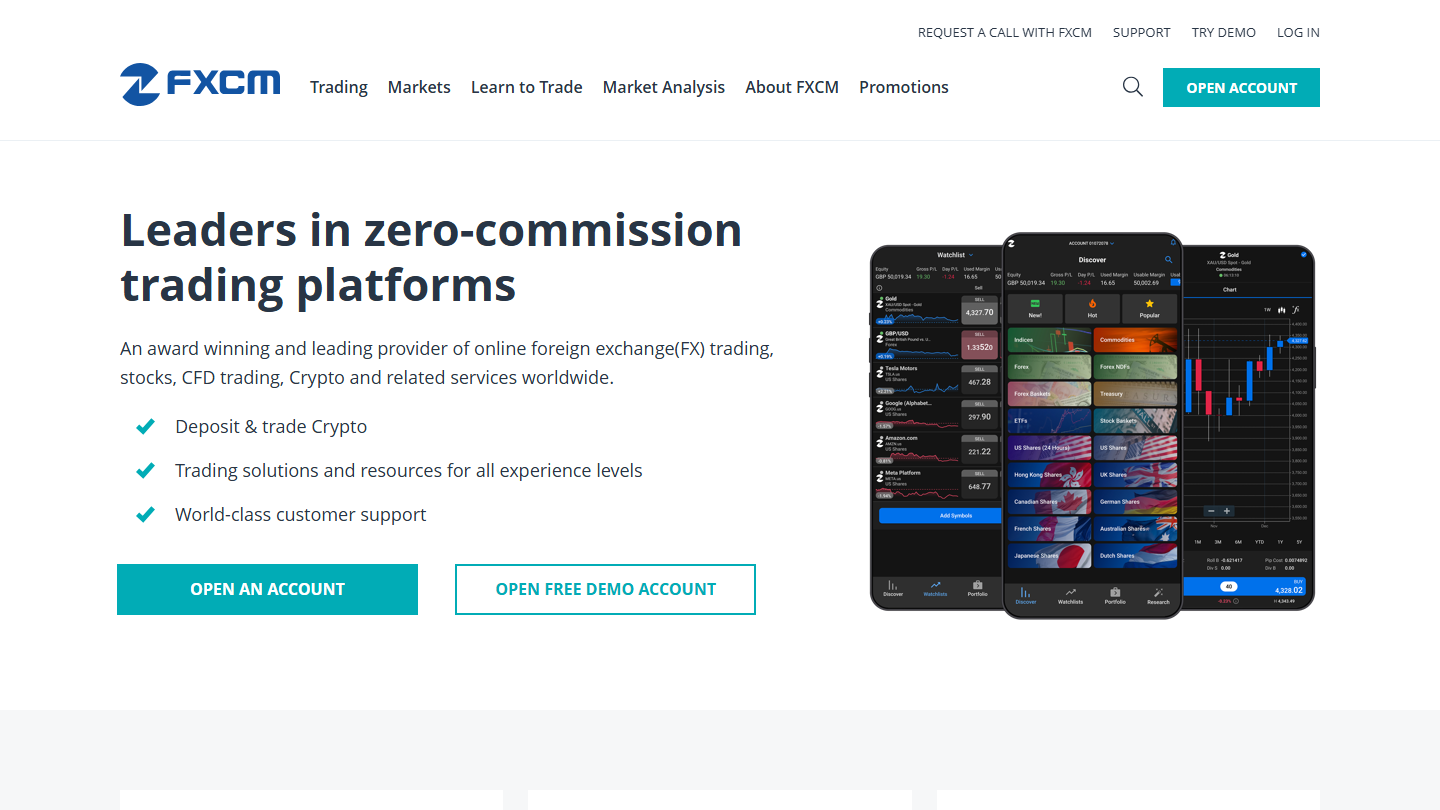
Trading Station is FXCM’s own platform and its strongest product, in desktop, web and mobile builds. Its charting module, Marketscope 2.0, opens in a separate window with a wide indicator and pattern library; chart loading was fast throughout our week of testing.
The reason to choose it is automation. Custom indicators and strategies are written in Lua, and the backtester accounts for historical slippage and trading costs rather than assuming perfect fills, making its output far more honest than MetaTrader 4’s strategy tester. If you build systems, this is materially better than the industry default.
MetaTrader 4 is available for its large third-party ecosystem of indicators and expert advisors, and TradingView is integrated with FXCM’s servers so orders can be placed from its interface directly. NinjaTrader 8 was available when we tested; at publication it no longer appears on FXCM’s own platform comparison page, and we have not verified whether it remains offered. MetaTrader 5 is not offered and was not when we tested. For anyone wanting MT5’s extra timeframes and asset coverage, that alone rules FXCM out.
Four APIs come free: REST, FIX, Java and ForexConnect. Working through the REST documentation ourselves, we found it clear and the GitHub examples usable by a competent programmer new to trading APIs.
Mobile apps
We tested the FXCM app on Android and iOS in February 2026. It covers the basics (one-tap order entry, charts, a subset of indicators, in-app deposits) but it is clearly the lesser product.
Two problems recurred. The watchlist did not always update in real time, forcing us to open an instrument individually to see its price, a poor property in a trading app. And the dashboard is cluttered enough to confuse a new user, with trade history not fully visible from the home screen.
| Item | Detail |
|---|---|
| App Store rating when we checked | Approximately 3.8 out of 5 |
| Google Play rating when we checked | Approximately 3.6 out of 5 |
| One-tap execution | Available |
| Deposits in app | Available |
The MetaTrader 4 app was more stable in our experience, at the cost of FXCM’s exclusive indicators such as Real Volume and Trader Sentiment.
Trading tools
The instrument range is the clearest weakness in the offering. When we reviewed it in the first quarter of 2026, FXCM listed just over 100 instruments.
| Category | FXCM | IG | Saxo Bank | IC Markets |
|---|---|---|---|---|
| Currency pairs | 40+ | 80+ | 185+ | 65+ |
| Indices | 15+ | 80+ | 40+ | 25+ |
| Commodities | 10+ | 35+ | 30+ | 22+ |
| Share CFDs | Limited | 12,000+ | 19,000+ | 1,600+ |
| Cryptocurrencies | Limited | 10+ | Not offered | 20+ |
| Total | 100+ | 17,000+ | 71,000+ | 2,200+ |
The gap is not marginal. If you want global shares, a broad index selection or less common commodities, FXCM will not have them, and our broker reviews cover several brokers that do. What it offers instead is depth on the majors: the main FX pairs, gold and oil all had good liquidity and acceptable fill speed on our account.
The analysis tools are genuinely differentiated. Real Volume reports actual traded volume rather than the much weaker tick-volume proxy most retail platforms show, Market Depth exposes the order book, and Trader Sentiment shows the buyer-to-seller ratio per instrument. A Market Scanner combines selected indicators into automated buy and sell readings: reasonable signals in our use, but no substitute for your own analysis.
Order execution
We placed 50 trades on a funded live account. FXCM operates a No Dealing Desk model, passing orders to liquidity providers, which in principle reduces the broker-client conflict of interest. That claim deserves a caveat here it would not deserve elsewhere: it is the exact representation the CFTC found to be false between 2009 and 2014. Different owners and four regulators now stand behind it, but no client can verify routing independently.
What we measured was solid. Most market orders filled in under one second in normal conditions. Slippage occurred on roughly 15% of our 50 trades, averaging 0.1 to 0.3 pips, and ran in both directions rather than consistently against us, which is what a fair routing arrangement looks like. Requotes were rare on the standard account.
Execution slowed around major economic releases, which is industry-wide rather than specific to FXCM, but it is the condition in which a stop is most likely to fill away from its level. Active Trader adds depth-of-market visibility, which helps size orders against available liquidity.
Deposits
We funded by card, and the balance appeared in under two minutes from entering the card details.
| Method | Minimum | Fee | Processing time |
|---|---|---|---|
| Credit or debit card | $50 | Free | Instant |
| Domestic bank transfer | Bank dependent | Free | 1-2 business days |
| International wire (SWIFT) | Bank dependent | Free | 3-5 business days |
| Skrill | $50 | Free | Instant |
| Neteller | $50 | Free | Instant |
FXCM charges nothing on deposits, but your own bank and any intermediary banks may charge on international transfers, a cost invisible until it appears. E-wallet availability varies by region and entity.
Withdrawals
Requests are submitted from the account dashboard and processed by FXCM within one to two business days.
| Method | Fee | Time to arrive |
|---|---|---|
| Credit or debit card | Free | Up to one billing cycle |
| International bank wire | $40 | 3-5 business days |
| UK domestic bank transfer | £15 | 1-2 business days |
| Skrill | Free | 1-2 business days |
| Neteller | Free | 1-2 business days |
We tested this rather than taking it on trust. When we requested a card withdrawal in February 2026, FXCM processed it within one business day and the money reached the card three business days later: no obstruction, no unexplained delay, no request for documents already supplied.
Two constraints matter. FXCM enforces a same-method rule: funds return by the route they arrived, so a card deposit must be withdrawn to that card up to the deposited amount, with anything above going by bank transfer. And the $40 wire fee is the standout weakness: brokers including IC Markets charge nothing, and withdrawing monthly costs $480 a year.
Customer support
Support runs on live chat, email and telephone, 24 hours a day, five days a week. It is not 24/7, so a weekend problem waits until Monday.
When we contacted live chat in February 2026 we had a reply in under two minutes, from an agent well briefed on platform mechanics, account tiers and fees, able to answer specific questions on order types and margin without escalating. Email replies came within a few hours and were detailed rather than templated.
| Channel | Availability | Response time when we tested |
|---|---|---|
| Live chat | 24/5 | Under two minutes |
| 24/5 | A few hours | |
| Telephone | 24/5 | Answered immediately |
When we checked in early 2026, FXCM held approximately 4.1 out of 5 across more than 850 Trustpilot reviews. We did not re-verify that score at publication, so treat it as a snapshot rather than a current figure. Recurring public complaints concern slow clearing on larger bank wires and confusion over which entity holds the account.
Research and education
Research is better than average for a broker this size: daily market reports and technical analysis, an economic calendar, and Trading Central signals alongside FXCM’s own work through FXCM Plus. Free downloadable historical price data is a quietly valuable feature; anyone testing a systematic strategy needs clean data, and most brokers either do not provide it or charge for it.
Education covers daily live webinars, video tutorials and written material from basics through candlestick analysis and chart patterns, solid rather than exceptional, and well short of what IG or Saxo produce.
Transparency is mixed. The analysis tooling is open and well documented; the pricing is not. Unpublished swap rates and an offshore group entity that is never prominently explained both work against a client trying to understand what they are signing up to.
Fund safety and protections
Segregation. Client funds sit in segregated accounts at approved banks, separate from operating capital, so they are not available to creditors if the firm fails, the base layer of fund safety at any licensed broker.
Negative balance protection. In place for all retail clients under the FCA, CySEC and ASIC entities, so you cannot lose more than your balance. It is a legal requirement rather than a courtesy, introduced after the January 2015 Swiss franc crisis, during which FXCM clients ran up negative balances of roughly $225 million; FXCM said it would absorb 90% of them.
Compensation schemes. UK clients are covered by the FSCS up to £85,000 per person, Cyprus clients by the Investor Compensation Fund up to €20,000. Australian clients have no equivalent scheme, and clients of the unregulated SVG entity have nothing at all.
| Protection | FCA (UK) | CySEC (Cyprus) | ASIC (Australia) |
|---|---|---|---|
| Segregated funds | Yes | Yes | Yes |
| Negative balance protection | Yes (retail) | Yes (retail) | Yes (retail) |
| Compensation scheme | £85,000 (FSCS) | €20,000 (ICF) | None |
| Retail leverage cap | 1:30 | 1:30 | 1:30 |
FXCM survived a genuine solvency shock in 2015 without wiping out its client base, which counts for something. It survived it by borrowing $300 million from the firm that eventually foreclosed on it, which is the more complete version of the story.
Verdict
FXCM is a legitimate, properly licensed broker with a long record that is not clean. We score it 6.9 out of 10.
That number comes from our six weighted categories rather than being carried across from any earlier assessment; the weights are on our ratings methodology page. Two categories drive it. Trading costs, at 20%, is FXCM’s weakest measured area: widest spread of the four brokers compared on every FX pair, plus $40 to wire money out. Regulation carries the heaviest weight at 25%, and while all four licences are active, the 2017 fraud finding and the unregulated offshore entity pull it below where the licences alone would place it.
Consider FXCM if you trade algorithmically, or can fund $25,000 for Active Trader pricing, or trade only major pairs and core commodities. Look elsewhere if you want a wide instrument range, you are cost-sensitive on a standard account, you withdraw by bank transfer regularly, or you want MetaTrader 5.
Risk warning: 65% of retail investor accounts lose money when trading CFDs with this provider. CFDs are complex instruments and leverage means losses build quickly. Consider whether you can afford that risk, and never trade with money you cannot afford to lose. Nothing here is investment advice or a prediction of results.
Is FXCM trustworthy?
Is FXCM a scam? No. We verified four licences, opened an account, traded it and withdrew money without difficulty. A scam broker does not hold an active FCA authorisation and does not return funds on request. But “not a scam” and “never misled clients” are different claims, and only the first is true of FXCM’s full history.
Why was FXCM banned from the United States, and does it still matter? The CFTC found in February 2017 that it had misrepresented its execution model while concealing its relationship with the market maker on the other side of client trades, fined it $7 million and required it and its founding partners to deregister permanently. It matters as context rather than current risk: the case is settled, the individuals are gone, ownership passed to a NYSE-listed parent, and today’s entities have no comparable finding. We reflect it in the regulation score.
Is there a current regulator warning against FXCM? Not against the firm. We found no enforcement action, suspension or restriction against any authorised FXCM or Stratos entity on the FCA, ASIC, CySEC or FSCA registers on 27 July 2026. There is an FCA warning about an impersonator calling itself “FXCM Germany” that quotes FXCM’s real firm reference number, a warning about criminals using the brand, not about the broker.
Can I withdraw my money? Yes. We requested a card withdrawal during testing; it was processed in one business day and arrived three business days later. The constraints are the same-method rule and the $40 wire fee, not obstruction.
Who owns FXCM, and which entity holds my money? Jefferies has owned it outright since September 2023, and reports in mid-2026 indicate it is exploring a sale (unconfirmed, but worth knowing). UK clients get the FCA entity, EEA clients the Cyprus entity, Australian clients the ASIC entity. The group also runs an unregulated St Vincent and the Grenadines company, so confirm which entity your agreement names before funding.
Frequently asked questions
Is FXCM regulated?
Yes, by four authorities: the FCA in the UK (217689, held by Stratos Markets Limited), ASIC in Australia (AFSL 309763), CySEC in Cyprus (392/20) and the FSCA in South Africa (FSP 46534). We confirmed all four active on 27 July 2026. The group also operates an unregulated entity in St Vincent and the Grenadines.
What is the minimum deposit at FXCM?
$50 by card on a standard account. Active Trader, which carries the tighter spreads, requires a $25,000 account balance.
Does FXCM offer a swap-free account?
Yes, across all four regulated entities, with no proof of religious observance required. Overnight interest is replaced by an administrative markup on the spread from roughly 0.4 pips, so total cost is slightly higher than a standard account. There is no independent Sharia certification.
Which platforms does FXCM offer?
Trading Station, MetaTrader 4 and TradingView, plus four free APIs: REST, FIX, Java and ForexConnect. NinjaTrader 8 was available when we tested but no longer appears on FXCM’s platform comparison page. MetaTrader 5 is not offered.
What are FXCM’s withdrawal fees?
Free by card and by Skrill or Neteller. International bank wires cost $40 per transaction and UK domestic transfers £15. A $50 annual inactivity fee also applies after 12 months without a trade.
Reader reviews
Traded with this broker? Tell others what actually happened.