
LiteFinance has been trading since 2005, rebranded from LiteForex in 2021, and runs one of the better-integrated copy-trading systems we have used. It is also, for almost everyone reading this, an offshore broker. The Cyprus licence is real and it is active; the entity that would actually hold your money is probably not the one holding that licence. Costs are the other problem: our Classic account averaged 2.0 pips on EUR/USD when peers were pricing 1.4 to 1.7. Most retail accounts lose money trading leveraged products.
Disclosure: we may earn a commission if you open an account through links on this page. It does not affect our findings, our scores, or the order brokers appear in. Read how we make money.
| Overall rating | 5.1/10 |
|---|---|
| Founded | 2005 (as LiteForex; rebranded LiteFinance in November 2021) |
| Headquarters | Limassol, Cyprus (EU entity); Kingstown, St Vincent and the Grenadines (global entity); Ebene, Mauritius (Mauritius entity) |
| Main licences | CySEC Cyprus 093/08 (Liteforex (Europe) Ltd); Mauritius FSC GB20025921 (LiteFinance Investment Limited); St Vincent registration 931 LLC 2021, which is not a licence |
| Minimum deposit | $10 on Cent; $50 on Classic and ECN |
| Spread from | 0.0 pips on ECN plus commission; 1.8 pips on Classic |
| Maximum leverage | 1:1000 offshore; 1:30 retail under the Cyprus entity |
| Instruments | 260+ |
| Swap-free available | Yes, on all three account types |
| Retail loss rate | Not published by LiteFinance; the ESMA sector figure for CFD brokers is above 74% |
We opened live accounts ($200 on ECN and $100 on Classic) and ran them for four weeks across January and February 2026. We placed 50 orders, requested a real withdrawal, and contacted support three times without identifying ourselves as reviewers. Licences, entity structure, client routing, the published fee schedule and ownership were all re-verified on 27 July 2026, and everything that has moved since is flagged in the section it belongs to.
Pros and cons
What we liked
- Twenty years of continuous operation, which is longer than most of the offshore field and counts for something.
- Copy trading that is genuinely built in rather than bolted on, with per-trader statistics covering win rate, trade count and a risk score.
- A $10 minimum on the Cent account, where the contract size is $1,000 instead of $100,000: a real way to trade live money at a size that cannot hurt you much.
- Three platforms: MT4, MT5 and cTrader, plus a browser terminal. Most brokers at this price point offer one or two.
- Execution held up. Of our 50 orders, 35 filled at the requested price, sub-second, with no requotes.
- Swap-free is available across all three account types, not restricted to a separate product.
- No deposit fees, payment-system charges reimbursed, and most withdrawal routes free.
What we did not
- Classic spreads were the widest in our comparison set on six of seven instruments. EUR/USD averaged 2.0 pips against 1.4 at Equiti and Amana.
- ECN commission reaches $10 per lot round turn on majors and $30 on minors, against $7 on Equiti’s Premier account.
- Outside the EEA, the contracting entity is registered in St Vincent and the Grenadines, which does not regulate forex or CFD trading at all.
- No FCA authorisation and no ASIC licence, so UK and Australian traders have no domestically authorised route to this broker.
- A $10 charge every 30 days once an account has been idle for 60 days, which is a short fuse by industry standards.
- A persistent pattern of third-party withdrawal complaints concentrated on the offshore entity, including bonus-condition and account-linkage disputes. Our own withdrawal was fine; the pattern is still there.
- LiteFinance publishes no client loss rate, and cost disclosure on the site is thinner than it should be.
Company information
LiteFinance began life as LiteForex in 2005 and changed name in November 2021 as part of a stated global expansion. The founder is frequently named in third-party write-ups, but the sources conflict and the company’s own corporate page names nobody, so we are not repeating a name we cannot stand behind.
The group markets itself on scale: more than three million clients and daily volumes in the tens of billions of dollars. Those figures are self-reported and they aggregate demo accounts and Cent accounts alongside funded standard accounts, so the number of traders running meaningful live balances is materially smaller than the headline. We report the claim; we do not endorse it, and we treat self-reported client counts the same way for every one of the brokers we cover.
The corporate structure is the part that matters, and it changed shape between our testing and this republication. When we checked the broker’s registered-offices disclosure on 27 July 2026, three entities were listed rather than the two we documented in testing. That third entity, in Mauritius, carries a real if light-touch licence, and it materially changes the description of what protection an offshore client has.
| Item | Detail |
|---|---|
| EU entity | Liteforex (Europe) Ltd, Cyprus, company number HE230122 |
| Global entity | LiteFinance Global LLC, St Vincent and the Grenadines, 931 LLC 2021 |
| Mauritius entity | LiteFinance Investment Limited, company number 178302 |
| Founded | 2005 |
| Rebrand | LiteForex to LiteFinance, November 2021 |
| Ownership change since | None located as at 27 July 2026 |
| Clients claimed | 3 million+, self-reported, all account types included |
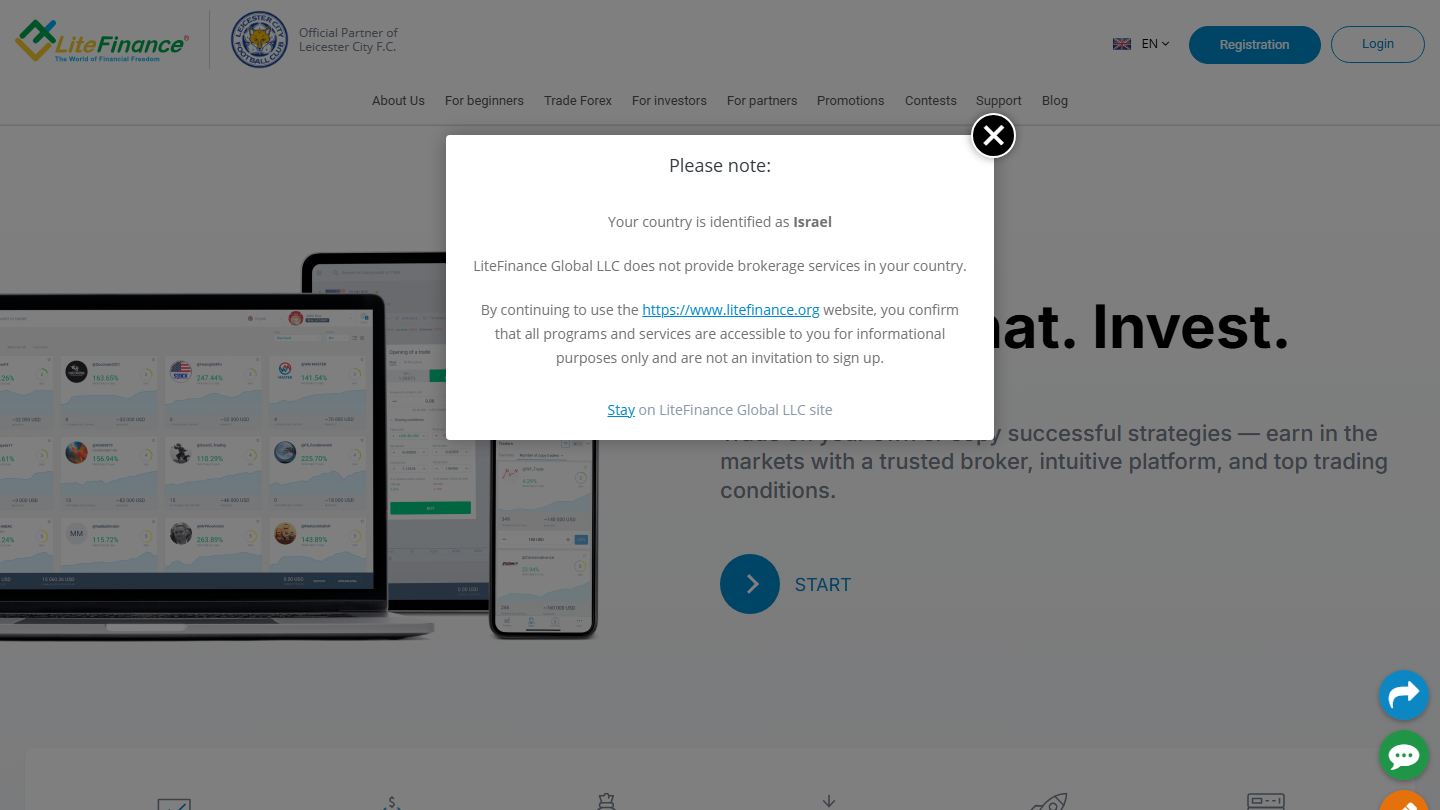
| Not served | United States, Israel, Russia and others; EEA residents are excluded from the global entity specifically |
Who this broker suits (and who it does not)
LiteFinance suits a narrow group well and a wider group poorly, and the dividing line is how much you care about who holds your money.
It works for someone starting out who wants to learn by watching. The copy-trading system was the strongest thing we tested. We allocated $50 each to three traders and the replication was fast and proportionally accurate, and the per-trader statistics were detailed enough to make an informed choice rather than a blind one. Paired with the Cent account, a beginner can put real money at real risk in amounts that make the lesson affordable. Copying somebody else’s trades does not make you likely to profit (the past results of a copied trader tell you nothing reliable about future ones), but it does let you observe entries, exits and sizing in a way a demo account never will. That caveat applies to every one of the best copy trading platforms, and LiteFinance is no exception.
It works for traders who want platform choice. Having MT4, MT5 and cTrader available at one broker is unusual at this end of the market, and cTrader in particular gives you Level II depth that neither MetaTrader platform exposes as cleanly.
It does not work for cost-sensitive active traders. On the numbers below, a Classic account holder pays roughly 0.6 pips more per EUR/USD round turn than at two of the three brokers we benchmarked against, and the ECN commission structure does not rescue it.
It does not work for anyone whose first requirement is regulatory protection. If you are in the UK there is no FCA-authorised LiteFinance entity to open an account with. If you are in Australia there is no ASIC licence. If you are in the EEA you get the Cyprus entity and the protections that come with it, but you also get 1:30 leverage rather than the 1:1000 the brand advertises, which is the trade the rules exist to make.
Licensing and regulation
Three entities, three very different levels of protection. Which one you get is decided by your country of residence, and you do not choose it.
Cyprus. Liteforex (Europe) Ltd holds CySEC licence 093/08. We verified this on the CySEC public register during testing and re-verified it on 27 July 2026; it remains active, with no suspension, restriction or conditions attached that we could find. This is a genuine tier-2 European licence carrying MiFID II obligations: segregated client money, negative balance protection, a 1:30 retail leverage cap, and membership of the Cyprus Investor Compensation Fund covering up to €20,000 per client if the firm fails.
St Vincent and the Grenadines. LiteFinance Global LLC is registered as 931 LLC 2021. A St Vincent registration is a company incorporation, not a financial licence. The territory’s Financial Services Authority has stated publicly that it does not regulate forex and CFD trading, and it supervises no part of this business. There is no compensation scheme, no regulatory leverage cap, and no supervisor to complain to. This entity explicitly does not serve EEA residents, which is precisely how it keeps offering 1:1000.
Mauritius. LiteFinance Investment Limited holds Financial Services Commission licence GB20025921 as an Investment Dealer (Full Service Dealer, excluding Underwriting), company number 178302. This is a real licence with real obligations, including client-money segregation, and it is a meaningful step above a bare St Vincent registration. It is not equivalent to CySEC, FCA or ASIC supervision, and there is no investor compensation scheme behind it.
The FCA warning entries. Anyone searching for this broker will find LiteFinance-adjacent names on the FCA Warning List, so it is better to explain them than to leave them hanging. On 16 December 2025 the FCA listed Liteforex Trades as an unauthorised firm operating at liteforextd.com. There is an older entry for Lite Forex Pro, flagged explicitly as a clone of an authorised firm. Neither names an operating entity of this broker, and the domain in the December entry is not one of LiteFinance’s; the group operates litefinance.org, my.litefinance.org, litefinance.mu and liteforex.eu. Our reading is that these are brand-impersonation alerts: warnings about the name, not enforcement against the business. We found no fine, suspension, licence restriction or client-money finding against any of the three operating entities on any register we checked. The substantive UK point is not the warning entries at all: the FCA authorises no LiteFinance entity whatsoever, which means any firm soliciting UK clients under this brand is unauthorised by definition. You can check any firm against the FCA Warning List yourself, and the Cyprus licence on the CySEC register of Cypriot investment firms.
| Entity | Regulator | Number | Tier | Protection |
|---|---|---|---|---|
| Liteforex (Europe) Ltd | CySEC, Cyprus | 093/08 | Tier 2 | ICF to €20,000, segregation, negative balance protection, 1:30 cap |
| LiteFinance Investment Limited | FSC, Mauritius | GB20025921 | Offshore, licensed | Segregation required; no compensation scheme |
| LiteFinance Global LLC | None | 931 LLC 2021 (registration only) | Unregulated | None enforceable |
Opening an account and verification
Registration took us under five minutes in January 2026. The form asks for name, email, phone and country of residence, and the confirmation email arrived in well under a minute. Country of residence is the field that decides which entity you contract with, so it is worth reading the small print on the page that follows rather than clicking through it.
Demo trading starts immediately, with no identity verification required. That is convenient and it is also the standard arrangement offshore.
Full verification needs two documents: photo ID (passport or national ID card) and a proof of address dated within three months. We uploaded ours through the client cabinet on 14 January 2026 and verification completed on 16 January (two business days), which is about the industry median.
One structural detail worth planning around: verification is required before your first withdrawal, not before your first deposit. You can fund an account and start trading unverified, then discover the document requirement at the exact moment you want your money out. Complete verification on day one.
The client cabinet itself is well organised. Accounts, deposits, withdrawals and copy-trading allocations all live in one place, which is more than can be said for several larger brokers.
Account types
Three accounts, and the choice between them is a straightforward spread-versus-commission decision.
Cent. A $10 minimum and a $1,000 contract size instead of $100,000. Gains and losses land at roughly a hundredth of standard scale. This is the most useful thing LiteFinance offers a beginner: live-money psychology at a size where a bad week costs the price of lunch. Spreads match Classic, and leverage still runs to 1:1000, which is exactly where a beginner should not go.
Classic. A $50 minimum, no commission, spreads from 1.8 pips on majors. Simple to reason about and expensive to trade. When we tested in early 2026, EUR/USD averaged around 2.0 pips against the 1.4 pips our Equiti review recorded on a comparable standard account.
ECN. A $50 minimum, spreads from 0.0, commission from $0.25 per lot rising to $10 round turn on majors. Our observed EUR/USD spread ran between 0.2 and 0.8 pips during active hours. This account also pays 2.5% a year on uninvested balance, which is a genuine and unusual perk, and it is the account cTrader is attached to.
Swap-free is available on all three. It is requested through the client cabinet and is applied automatically for clients in a number of countries. Two limits matter and they are not always spelled out: positions held beyond about a week can attract an administrative charge, and the broker reserves the right to withdraw the facility where it believes it is being used to avoid financing costs rather than for its intended purpose. Neither is unusual, and both are worth knowing before you rely on the feature.
| Feature | Cent | Classic | ECN |
|---|---|---|---|
| Minimum deposit | $10 | $50 | $50 |
| Spread from | 1.8 pips | 1.8 pips | 0.0 pips |
| Commission | None | None | From $0.25 per lot |
| Maximum leverage | 1:1000 | 1:1000 | 1:1000 |
| Contract size | $1,000 | $100,000 | $100,000 |
| Minimum trade | 0.01 lot | 0.01 lot | 0.01 lot |
| Platforms | MT4, MT5 | MT4, MT5 | MT4, MT5, cTrader |
| Swap-free | Available | Available | Available |
| Interest on balance | No | No | 2.5% a year |
Fees and trading costs
This is where LiteFinance loses most of its ground. We re-checked the published fee schedule on 27 July 2026 against the figures we measured in February; nothing has been repriced.
Spreads
When we tested in early 2026, Classic EUR/USD ranged from 1.8 to 3.2 pips and averaged close to 2.0 during active hours. Spreads widened noticeably in thin conditions before the London open and after the New York close, which is normal, but the base was already wide. On ECN the same pair sat between 0.2 and 0.8 pips before commission.
The comparison below uses Classic, the no-commission account, benchmarked against three competitors over the same period.
| Instrument | LiteFinance Classic | Equiti Standard | Amana Classic | XM Standard |
|---|---|---|---|---|
| EUR/USD | 2.0 pips | 1.4 pips | 1.4 pips | 1.7 pips |
| GBP/USD | 2.8 pips | 1.8 pips | 1.9 pips | 2.1 pips |
| USD/JPY | 2.2 pips | 1.5 pips | 1.6 pips | 1.8 pips |
| AUD/USD | 2.5 pips | 1.7 pips | 1.8 pips | 1.9 pips |
| USD/CHF | 2.4 pips | 1.8 pips | 1.9 pips | 2.0 pips |
| Gold (XAU/USD) | 32 points | 25 points | 28 points | 30 points |
| Oil (WTI) | 5.0 points | 4.0 points | 4.5 points | 3.5 points |
LiteFinance is the widest of the four on six of seven instruments. On EUR/USD the gap to Equiti and Amana is about 0.6 pips, roughly $6 per standard lot round turn. Trade once a week and it is noise. Trade daily and it is a few thousand dollars a year taken out of the account before any strategy has been tested.
Commissions
Cent and Classic charge none. ECN commission starts at $0.25 per lot but reaches $10 per lot round turn on majors, $30 on minors and exotics, and $12 on crypto pairs. For comparison, Equiti’s Premier account charges $7. The zero-spread headline on ECN is real; the all-in cost is not competitive.
Overnight financing
We sampled swap charges across several pairs in the second week of February 2026 and found them within the normal range for a broker of this size. Triple swap is charged on Wednesdays to cover the weekend, which is standard practice.
Deposit, withdrawal and inactivity fees
Deposits are free and LiteFinance reimburses payment-system charges, which makes funding genuinely costless in most cases. Most withdrawal routes are free; SticPay costs 2.5% plus $0.30 and some regional rails carry their own charges.
The inactivity fee is the one to watch. An account with no trades and no balance operations for 60 days is classified dormant and charged $10 every 30 days. Connecting to the platform does not count as activity, and neither does placing a pending order; you have to open and close a position or move money. Sixty days is short; many brokers allow six or twelve months. Re-verified on 27 July 2026 and unchanged.
Overall, trading costs sit below the sector average on both account types. That is the finding, and it is not close.
Desktop platforms
Platform range is one of LiteFinance’s real strengths. Three third-party platforms plus a browser terminal is more choice than most brokers in this bracket provide.
MetaTrader 4 is the familiar workhorse: expert advisors, 30-plus built-in indicators, unlimited custom ones. Connections to LiteFinance’s servers were stable throughout our four weeks with no disconnects worth recording.
MetaTrader 5 adds an economic calendar, 38 indicators, 44 graphical tools, more order types and access to a wider asset range including equities and futures.
cTrader was the most interesting of the three. The interface is more modern than either MetaTrader build, the charting is smoother, and it exposes Level II depth of market, which is useful if you want to see the order book rather than trust a single quote. It is attached to the ECN account.
The web terminal handles quick manual trades adequately and lacks the depth of the installed platforms. Fine as a backup, not as a primary.
One irritation: the copy-trading system lives in the client cabinet, not inside any of the three platforms. Running copied positions alongside manual ones means keeping a browser tab and a terminal open and reconciling between them.
Mobile apps
We tested on Android and iOS in February 2026. Alongside the standard MT4, MT5 and cTrader apps, LiteFinance ships its own, and the proprietary app is the better proposition because it puts manual trading and copy trading in one interface. You can browse traders, review their statistics and start or stop copying without leaving the app.
It covers 190-plus instruments with over 100 drawing tools and 75 indicators, which is generous for a mobile build. Performance was fine on current handsets. The consistent weak point was loading the copy-trading leaderboards on a poor connection, where the app stalled noticeably. Charting is clear and customisable but not a substitute for a desktop screen.
The MetaTrader mobile apps behave as they do everywhere: order entry, charting and pending-order management all work, while automated strategies and custom indicators do not carry over from desktop.
Mobile here is competent and unremarkable, with copy-trading integration as the one genuine differentiator.
Trading tools
The instrument list runs past 260. Reasonable, not broad. Availability varies by account type and platform; Cent carries fewer instruments than Classic and ECN.
Crypto is the standout. Around 66 pairs is well above what most brokers of this size list, covering the majors plus a long tail including Monero, Zcash, Dash and Ethereum Classic. Forex coverage of roughly 56 pairs is adequate for any mainstream strategy. Share CFDs at around 122 names cover US and European large caps. Commodities at seven and indices at eleven are thin: enough for gold, oil and the headline indices, not enough for anything more specialised.
| Category | Approximate count | Coverage |
|---|---|---|
| Forex | 56 pairs | All majors, plus minors and exotics |
| Share CFDs | 122 | US and European large caps |
| Cryptocurrency | 66 pairs | Majors plus an unusually long tail |
| Commodities | 7 | Gold, silver, WTI, Brent, natural gas |
| Indices | 11 | S&P 500, Dow, NASDAQ, DAX, FTSE 100, Nikkei 225 |
Order execution
We placed 50 orders on a funded account across February 2026, deliberately spread between the London–New York overlap and quieter periods.
LiteFinance describes itself as ECN/STP with no dealing desk. What we measured is consistent with that. Fills on the ECN account were sub-second in the large majority of cases during active hours, and we recorded no requotes at all across the test.
Slippage was symmetrical, which matters more than raw speed. Of 50 orders, 35 filled at the requested price exactly, 8 slipped against us by 0.1 to 0.3 pips, and 7 slipped in our favour. A broker filling you worse than requested several times as often as better is running something you should not accept; this was close to even.
One caveat we did not experience but will not omit: other reviewers and traders have reported incidents involving positions opened at sizes they did not request, or orders accepted without adequate margin, around server maintenance windows. We saw nothing of the sort in four weeks. Use stop-losses regardless.
Order types cover market, limit, stop, stop-loss, take-profit and trailing stop. That is enough for any mainstream approach.
Deposits
Funding is the smoothest part of the operation. Our Visa deposit credited in under a minute, and LiteFinance lists more than 20 funding routes, which is generous.
Cards. Visa and Mastercard, no fee, instant. The minimum follows the account type: $10 for Cent, $50 otherwise.
E-wallets. Skrill, Neteller, Perfect Money, Volet (formerly Advanced Cash) and SticPay. Free and instant in most cases.
Bank transfer. $100 minimum, three to five business days. LiteFinance charges nothing; your sending bank may.
Crypto. Eight coins including Bitcoin, Ethereum, Tether, Litecoin, Bitcoin Cash, Ripple, Monero and Dash. Free, with confirmation time set by the network rather than the broker.
The reimbursement policy on payment-system charges is a real benefit and rarer than it should be. Note the mirror-image risk: money that arrives instantly and free can leave slowly, and funding convenience tells you nothing about withdrawal reliability.
| Method | Fee | Minimum | Processing |
|---|---|---|---|
| Visa / Mastercard | Free | $10–$50 | Instant |
| Skrill | Free | $10–$50 | Instant |
| Neteller | Free | $10–$50 | Instant |
| Perfect Money | Free | $10–$50 | Instant |
| Bank transfer | Free from LiteFinance | $100 | 3–5 business days |
| Bitcoin / Ethereum / Tether | Free | $10–$50 | Network dependent |
Withdrawals
We requested $150 back to the funding Visa card on 5 February 2026. Approval came through within hours. The money reached the card four business days later. LiteFinance states it processes approved requests within 24 hours, and our experience matches that on approval; the four days were settlement, which sits with the card scheme rather than the broker. It is still four days, and better brokers clear cards in one or two.
Most routes are free: cards, Skrill, Neteller, Perfect Money and most crypto. SticPay costs 2.5% plus $0.30. Auto-withdrawal handles up to $5,000 a day without manual approval across cards, bank transfers, e-wallets and crypto, which is a well-designed feature.
Now the part that keeps this section’s score down. Reviewing independent complaint platforms, we found a substantial and persistent volume of withdrawal complaints: requests held for weeks, and profits cancelled on grounds of bonus-term breaches or alleged account linkage. These cluster on clients of the offshore entity rather than the Cyprus one, which is exactly the pattern you would predict. The offshore entity has no supervisor to escalate to, so a disputed withdrawal has nowhere to go.
Our own withdrawal was clean and we will not pretend otherwise. But one successful $150 withdrawal is weak evidence against a recurring pattern, and we would be misleading you to present it as a rebuttal. Two practical precautions follow: test the withdrawal path with a small amount before funding seriously, and decline bonuses. Bonus terms are the single most common mechanism by which withdrawal disputes at offshore brokers become unwinnable.
Customer support
Support runs 24 hours a day, five days a week, across live chat, email and phone, in more than 15 languages. Note the 24/5, not 24/7. A weekend problem waits until Monday.
We contacted live chat three times during testing. The first, mid-morning on a Tuesday, was answered in four minutes with a clear and correct explanation of how to convert an account to swap-free. The second, a Wednesday afternoon, took 12 minutes and produced an answer on leverage settings that was accurate but shallow. The third, a Thursday evening, was answered in six minutes.
The pattern across all three: account, funding and withdrawal questions were handled competently and quickly. Detailed technical questions about trading conditions or platform behaviour tended to get escalated rather than answered, which costs you a round trip. Response times were good; depth was average.
The published FAQ is thorough and answers most routine questions faster than chat will.
Research and education
The content library is larger than most brokers at this level maintain, and uneven in quality.
The blog runs to hundreds of articles spanning beginner concepts through to strategy and technical analysis. The introductory material (what leverage does, how order types work, basic risk management) is clearly written and genuinely useful to someone starting out.
Daily analysis covers the major pairs plus gold and oil, combining technical and fundamental commentary with annotated charts. We followed it through February 2026 and found it reasonable: not a trading edge, but a competent daily briefing.
The copy-trading system doubles as an educational tool, and this is the most interesting thing here. Watching an experienced trader’s entries, exits and position sizing in real time teaches something no article does. It also encourages the error of treating a good three-month track record as predictive, which it is not.
What is missing is structure: no regular webinar programme, no sequenced learning path. And on transparency, LiteFinance publishes no client loss rate, a disclosure European-regulated brokers are compelled to make and offshore ones generally avoid. Cost information on the site also became harder to locate after the rebrand than it needs to be.
Fund safety and protections
Protection depends entirely on which entity holds your account, and the gap between the best and worst case is wide.
Segregation. LiteFinance states client funds are held separately from company funds at tier-1 banks. Under CySEC this is a legal requirement with supervisory teeth. Under the Mauritius FSC licence, segregation is also a licence condition. Under the St Vincent registration it is a promise with nothing behind it: no supervisor verifies it and no penalty follows if it is not honoured.
Negative balance protection. Mandatory for the Cyprus entity under ESMA rules and advertised on the global entity too. It is worth reading the terms of whichever entity you contract with rather than assuming: the group’s own documentation does not extend the same guarantee uniformly across every company in the group. At 1:1000 leverage this is not a theoretical concern.
Compensation. Liteforex (Europe) Ltd participates in the Cyprus Investor Compensation Fund, which covers up to €20,000 per client if the firm fails. Neither the Mauritius nor the St Vincent entity has any equivalent. If your entity becomes insolvent, there is no scheme to claim against and you are an unsecured creditor in a jurisdiction you have never visited.
The honest summary: for an EEA client, fund safety is decent and multi-layered. For everyone else, the protections are either licence conditions in a light-touch jurisdiction or voluntary undertakings with no enforcement behind them. That does not mean your money is at risk today. It means that if something goes wrong, the mechanisms that would normally get it back for you largely do not exist.
| Protection | Cyprus (CySEC) | Mauritius (FSC) | St Vincent |
|---|---|---|---|
| Client money segregation | Required and supervised | Licence condition | Stated, not enforceable |
| Negative balance protection | Guaranteed under ESMA | Check entity terms | Stated, not guaranteed |
| Compensation scheme | ICF to €20,000 | None | None |
| Maximum leverage | 1:30 retail | 1:1000 | 1:1000 |
| Supervisor to complain to | CySEC | Mauritius FSC | None |
Verdict
LiteFinance scores 5.1 out of 10 on the six-category framework behind all our broker reviews. It is a functioning broker with a two-decade record, an unusually good copy-trading system, three platforms, and an entry point low enough to be genuinely useful for learning. It is also expensive to trade and, for most of this site’s readers, offshore in a way that removes protections you would otherwise take for granted.
That number is lower than the 3.6 out of 5 we published in our original Arabic assessment, and the reason is the scoring model rather than any deterioration at the broker. The Arabic version scored a seventh category (Arabic-language trading experience) at 15%, and LiteFinance did well in it. This site does not score that category, and it weights regulation at 25% and withdrawals at 20%, which are exactly the two areas where LiteFinance is weakest for a UK, EU or Australian reader. Removing a strength and increasing the weight on two weaknesses moves the number, and when the arithmetic disagrees with a prior verdict, the arithmetic wins. Read our methodology.
| Category | Weight | Score |
|---|---|---|
| Regulation and licensing | 25% | 3.5 |
| Trading costs | 20% | 4.5 |
| Withdrawals and fund access | 20% | 5.0 |
| Platforms and execution | 15% | 7.5 |
| Customer support | 10% | 6.0 |
| Research and transparency | 10% | 5.5 |
| Overall | 100% | 5.1 |
Consider LiteFinance if you want to learn by copying experienced traders with small sums, you want platform choice including cTrader, or you want a broad crypto CFD list. Look elsewhere if you trade actively enough for spreads to matter, you are in the UK or Australia and want a domestically authorised broker, or regulatory protection is your first filter rather than your last.
CFDs are leveraged products and most retail accounts lose money trading them. At 1:1000, losses accumulate as fast as gains and faster than most beginners expect. Never trade money you cannot afford to lose, and treat any broker’s marketing, including the 2.5% balance interest and the copy-trading track records, as advertising rather than evidence.
Is LiteFinance trustworthy?
Is LiteFinance a scam?
No. It has operated for twenty years, holds a verifiable and active CySEC licence, and we deposited, traded and withdrew successfully. But “not a scam” and “well protected” are different claims. If you are outside the EEA you contract with an entity that either sits in a light-touch offshore jurisdiction or in one with no financial supervision of this activity at all, and the recurring withdrawal complaints on independent platforms are real. Start small.
Why does LiteFinance appear on the FCA Warning List?
Two similarly named firms appear, neither of which is an operating entity of this broker. “Liteforex Trades” was listed on 16 December 2025 as an unauthorised firm at liteforextd.com, not a LiteFinance domain. “Lite Forex Pro” is flagged as a clone of an authorised firm. These are impersonators trading on the brand. The point that does affect you is different and more important: the FCA authorises no LiteFinance entity at all, so there is no FCA-regulated route to this broker, and no Financial Services Compensation Scheme or Financial Ombudsman access if something goes wrong.
Which entity will hold my money?
Your country of residence decides, and you cannot choose. EEA residents get Liteforex (Europe) Ltd under CySEC, with compensation cover and a 1:30 leverage cap. LiteFinance Global LLC in St Vincent explicitly does not serve EEA residents and takes much of the rest of the world. LiteFinance Investment Limited holds a Mauritius FSC dealer licence. Check which entity’s terms you are being asked to accept at registration; it is disclosed, but not prominently.
Can I actually get my money out?
We did. $150 requested on 5 February 2026, approved within hours, in the account four business days later, no document chase. Against that, independent complaint platforms carry a persistent volume of reports of held withdrawals and cancelled profits, concentrated on offshore-entity clients and frequently involving bonus terms. Both things are true. Test the path with a small withdrawal before you fund seriously, and do not accept bonuses.
Is the CySEC licence genuine?
Yes. Liteforex (Europe) Ltd, company number HE230122, holds CySEC licence 093/08. We verified it on the public register during testing and again on 27 July 2026, and it was active both times with no restrictions we could find. The caveat is that it covers one of three entities, and probably not yours.
Frequently asked questions
What is the minimum deposit at LiteFinance?
$10 on the Cent account and $50 on Classic and ECN. These are among the lowest in the industry. A very small balance limits your ability to size positions sensibly, so treat the Cent account as a learning tool rather than a starting capital base.
Does LiteFinance offer swap-free accounts?
Yes, on all three account types. It is requested through the client cabinet and applied automatically for clients in some countries. Two limits: positions held beyond roughly a week can attract an administrative charge, and the broker reserves the right to withdraw the facility where it believes it is being misused.
How does LiteFinance copy trading work?
You browse a list of traders with published statistics (win rate, trade count, risk level), allocate capital to the ones you choose, and their trades replicate in your account scaled to your balance. Replication was fast and proportionally accurate in our testing. Copying does not make profit likely, and a strong past record is not evidence of future results.
What are LiteFinance’s biggest drawbacks?
Classic spreads from 1.8 pips, averaging 2.0 on EUR/USD in our testing and the widest of the four brokers we benchmarked. ECN commission up to $10 per lot on majors and $30 on minors. An offshore contracting entity for most clients, with no compensation scheme. A $10 monthly inactivity charge after only 60 days. And a recurring pattern of third-party withdrawal complaints.
What leverage does LiteFinance offer?
Up to 1:1000 through the offshore entities and 1:30 for retail clients of the Cyprus entity, where ESMA rules apply. The 1:1000 figure is a marketing headline, not a recommendation. At that leverage a 0.1% adverse move wipes out a fully margined position, and most retail accounts trading leveraged products lose money.
Does LiteFinance charge an inactivity fee?
Yes. After 60 days with no opened or closed positions and no balance operations, the account is classified dormant and charged $10 every 30 days. Logging in and placing pending orders do not count as activity. Withdraw your balance if you plan to stop trading for a while.
Reader reviews
Traded with this broker? Tell others what actually happened.